Specifiction is reader-supported. When you buy through links on our site, we may earn an affiliate commission. As an Amazon Associate I earn from qualifying purchases. Learn more
Audjust AI Music Remixer is the clearest fit when you need to transform a song you own toward 92 BPM: it accepts a target tempo from 60 to 200 BPM, although the measured result may be close to the goal rather than exact. ACE-Step API is a second option when an API workflow suits you; its Music Remixer supports a new tempo, but the available information does not establish how to request precisely 92 BPM. Neither option is documented here as a guaranteed exact-tempo generator.
How These Options Fit 92 BPM
| Tool | Documented 92 BPM path | Generation details | Rights and limits |
|---|---|---|---|
| Audjust AI Music Remixer | Set a target tempo within its 60–200 BPM goal range; output may land near the target. | 30 credits per generation. | Upload only music you own or have permission to transform. A remix does not remove rights attached to the source. |
| ACE-Step API | Music Remixer supports a new tempo. Exact 92 BPM input behavior is not stated. | 5–10 credits per generation. Text-to-music can be started with one REST call; generation uses asynchronous tasks. | Output is described as royalty-free. Check the vendor’s terms for details relevant to your use. |
At 92 beats per minute, one quarter-note beat lasts about 0.652 seconds, and a four-beat bar lasts about 2.61 seconds. That gives a useful planning reference for loops, phrase lengths and edits, but it does not tell you whether a generated file actually holds a steady 92 BPM. A tempo target and a measured, consistent pulse are different things: a track can average near 92 while drifting, or it can have a clear pulse that a listener hears in half-time or double-time.
As an Amazon Associate I earn from qualifying purchases.
For this tempo, decide what the pulse should feel like before generating. A relaxed 92 can support spacious beats and longer vocal lines; a more driving arrangement can subdivide each beat into eighth notes or use syncopation. Those are arrangement choices, not special features established for either product. If your project needs a click-tight backing track, loop, or synchronization with video, listen and measure the resulting audio in your own editing or music software. The product facts here do not establish a built-in tempo analyzer or a guarantee of exact timing.
Ranked Picks
1. Audjust AI Music Remixer
Choose Audjust when the starting point is an existing song and the goal is to reshape it around a specified tempo. The documented workflow lets you upload a song you own, choose a genre and target tempo, guide vocal and melody direction, and generate a newly arranged version through its cover pipeline. Its supported goal range includes 92 BPM. The important qualification is that the measured result may be near the goal rather than exactly 92, so plan to check the output before treating it as a fixed-tempo asset.
Shopping ad
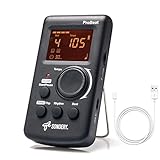
- Direct and fast setting of beat, tempo, rhythm by buttons and knobs. Easily reading color screen helps a lot to understand what you want out of your Sondery brand ProBeat digital metronome.
- Vocal counting option, and 3 types of digital sounds. Big sound out of a speaker. While the LED light on the top gives a clear visual tempo indication and the earphone plug is great for practicing without click or during performance.
- Easily setting tempo by a rotary dial ranging from 40 to 208bpm. 10 beat patterns including 0, 1, 2, 3, 4, 5, 6, 7, 8, 9. And Sondery ProBeat metronome covers all the needs of different rhythm training.
- Tap function allows you to enter your own tempo by each 2 taps. Timer function to set practice time length at 15 minutes, 30, 45 and 60 minutes. Sondery digital metronome helps improving your timing in a rich variety of musical styles.
- Digital metronome is powered by chargeable Li battery inside. Charge ProBeat metronome from any 5V USB power source. Pocket size 5*3*1inch. Weight only 0.26lb.
A practical starting brief is: “Target 92 BPM; keep the vocal phrasing clear; use a restrained drum pulse; leave space between phrases; guide the melody toward a warmer, more spacious direction.” Treat those words as creative direction, not a promise about controls or results. Audjust’s documented workflow supports choosing the tempo and guiding vocal and melody direction, but the supplied facts do not establish how precisely each descriptive instruction will be followed. Try a generation, listen to the beat against a 92 BPM reference, then refine the brief if the groove or vocal density is wrong. Each generation costs 30 credits.
For a song you want to use as source material, ownership or permission to transform it is required. A newly arranged version does not erase composition, recording, publishing or Content ID rights connected to that source. Get permission where needed, and check Audjust’s terms for the intended use of the generated result.
Free tools Windows power users keep installed
One-click scans. No signup required.
Shopping ad

- 🎵[Modern and Classic Design] : SDREAM Digital Metronome with LCD display makes practice much easier.This Electronic metronome retains the classic pyramid-shaped design while incorporating elements of modern style. It not only inherits the classic appearance but also improves its precision and ease of use. Moreover, they are durable.
- 🎵[Feature Rich Metronome]: There are two voice options: human English voice beats / electronic metronome beats. The digital metronome for guitar has 10 rhythm patterns.Direct and fast setting of metronome speed, beat, tempo, rhythm by buttons on SDREAM digital metronome.The tempo speed can be easily set within the range of 40 to 208 beats per minute.
- 🎵[Rechargeable Modes]: You can also use the Type-C charging cable provided by SDREAM store for power supply which can work for more than 8 hours. It also has a 3.5mm headphone jack for Immersive practice without disturbing others.
- 🎵[Suitable for all instruments]: SDREAM Digital Metronome is highly suitable for both beginners and seasoned musicians,10 beat patterns including 0, 1, 2, 3, 4, 5, 6, 7, 8, 9 meeting the requirements of playing all musical instruments such as piano, guitar, violin, bass, ukulele, trumpet, Harmonica, Saxophone, drum, etc. Universal metronome with vocal counting is the best gift for family and friends.
- 🎵[Compact and convenient]:This electronic metronome for piano is only the size of a palm and Weight only 0.29lb. Digital metronome for musicians is compact and easy to carry. SDREAM digital metronome for piano can be easily put in a pocket or a musical instrument bag. Especially for those who need to practice or perform outside frequently,the portability advantage of digital metronome is more obvious.
2. ACE-Step API
ACE-Step API is the more relevant choice when you want to build generation into a software workflow. Its text-to-music path starts from a single REST call and uses asynchronous tasks; its Music Remixer is described as supporting a new style, tempo or vocals. That makes a tempo-oriented remix plausible, but the documented information does not confirm that a request can specify exactly 92 BPM, nor does it give a tempo range or accuracy guarantee. Treat it as a candidate to evaluate, not an assured 92 BPM solution.
A useful experiment is to make the tempo requirement explicit in the request or remix brief, for example: “Aim for a steady 92 BPM, with a clear quarter-note pulse and room for an eighth-note subdivision.” This is an example of wording to try, not a verified API parameter or a guarantee that the service will honor the number. The API description confirms text-to-music and a remixer that can change tempo, but does not establish a field name, prompt syntax or exact-BPM behavior. Confirm those specifics in the vendor documentation before building around them. Generations cost 5–10 credits each; the exact cost within that range is not specified here.
Shopping ad

- Enhanced Design Upgrade – The SQ-50-V improves on the classic SQ50 with a sleek new look, upgraded interface, and even easier operation for musicians of all levels.
- Precision Tempo Control – Effortlessly set tempos from 40 to 208 BPM using the intuitive 39-position rotary dial—ideal for dialing in accurate timing for practice or performance.
- Adjustable Volume & Click Options – Choose between two distinct click tones (high or low) and adjust the volume to suit your environment—perfect for solo practice or group rehearsals.
- Built-In Tone Generators (A & Bb) – Tune your instrument with the built-in A=440Hz tone or the optional Bb tone, making this metronome a versatile tool for brass, strings, and woodwind players alike.
- Visual Beat with LED & Earphone Jack – Follow the beat with a red LED light for visual cueing, or combine it with audible clicks. Includes an earphone jack for silent practice in any setting.
The service describes its output as royalty-free. That label alone does not answer every question about a particular release, sample, voice or use case. Review the current terms and any source-material requirements before publishing or distributing the result. If you use a remix as a substitute for a particular recording or performance, confirm that you have the necessary consent and rights for the material you provide.
A Reliable 92 BPM Workflow
- Define what the number means. State that you want 92 quarter-note beats per minute, then decide whether the track should feel laid-back or energetic. A half-time feel can make the same underlying tempo feel slower; subdivisions can make it feel busier.
- Choose the matching source path. Use Audjust when transforming an owned or authorized song is central. Consider ACE-Step API when you need a text-to-music or REST-based workflow and can verify how its tempo request works.
- Keep the first brief focused. Specify the 92 BPM goal and only the arrangement qualities that matter most, such as pulse clarity, space for a vocal, or restrained percussion. Add more directions only after hearing what the first result misses.
- Check the generated audio. Compare the pulse against a 92 BPM click or use a tempo measurement tool available in your existing music software. Check more than the opening: listen for changes in pulse across sections and inspect the portion you intend to loop or synchronize.
- Revise based on the problem. If the pulse is steady but feels wrong, adjust the groove description. If it drifts or misses the target, do not assume a prompt can correct it; check the vendor’s available controls and try another generation only if its terms and credit cost work for you.
- Clear the material before release. Confirm permission for any uploaded source song, sample or voice, and review the relevant platform terms for the result’s intended distribution.
What to Verify Before You Commit
Neither listing establishes support for a particular genre, instrument, export format, mobile or desktop app, or exact synchronization workflow. The API listing says it can produce production-grade audio when studio_quality: true is sent, with vocals, instrumentation and mix handled, but it does not establish that this setting improves tempo accuracy. Check each vendor’s current documentation for the specific controls, file delivery, licensing details and integration requirements you need. For work that depends on a precise 92 BPM grid, make measured playback—not a stated target—the acceptance check.
Quick Recap
Shopping ad

- Compact 3-in-1 Design: Combines a digital metronome, chromatic tuner, and tone generator in one pocket-sized unit. Easy to carry in your instrument case—perfect for daily practice, music lessons and performances
- Versatile Digital Metronome: Adjustable tempo from 30–260 BPM, 10 beat patterns (0–9), and 8 rhythm styles help you improve timing and groove across multiple musical genres
- Fast, Precise Tuning for Multiple Instruments: Supports A0–C8 tuning range, A4 calibration (430–450Hz), and ±0.5 cent accuracy. Ideal for guitar, bass, violin, ukulele, mandolin, flute, trumpet, and other string or wind instruments. (Note: This AMT-560 tuner is not suitable for piano tuning. )
- Clear Backlit Display & Multi-Sense Feedback: The large LCD screen with 45° angled design ensures perfect readability in any light. Combined with bright LED lights and clear sounds, it provides intuitive visual and auditory rhythm cues. Adjustable volume and headphone jack allow silent or loud practice anywhere
- Practical Tone Generator for Ear Training: Quickly switch modes to generate precise reference tones. An essential tool for developing intonation, perfect pitch, and meeting specific rehearsal or performance requirements
Shopping ad
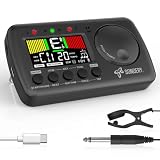
- 3 in 1 metrotuner. The MetroTune combines a tuner, a metronome and a tone generator in a pocket size device. Equipped with beautiful colors screen, 3 indicators, loud speaker, Mic and cable jack detections, earphone output, volume wheel and folding kickstand to make operation super easy.
- English vocal metronome with tap tempo. A broad range of tempo 30-260bpm, setting self tempo by tap, beats from 0 to 9, and various 8 rhythms. English vocal counting greatly helps follow the timing under a correct beat.
- Versatile tuner. The fast and accurate tuner features various tuning items for chromatic, guitar, bass, ukulele, acoustic guitar, electric guitar, violin, mandolin, piano, saxophone, trumpet, and other wind instruments, and also 12 different tuning keys, with pitch calibration from 410Hz to 450Hz, by tuning method using internal mic or enclosed pickup cord.
- Jog dial designed to easily use. The JOG Dial allows you to easily and quickly get a desired tempo for metronome, and to swift to a pitch in the Tone Generator and the Tuner.
- Power rechargeable. Plug to 5V USB power source with enclosed type C USB cord to charge the device. Equipped with a large LCD color screen and LED indicator, making it very user-friendly, especially in dark environments. MetroTune comes with instructions in seven languages, making it easy for musicians around the world to use.




