CarbonTool
- 1Runs onAPI, Web
- 2CostsFree plan · free trial · paid from $166.67/mo
- 3Scope coveragescope 1-3
- 4Data collectionboth
- 5Emissions factorsboth
- 6Supplier engagementYes
- 7Audit trailYes
- 8API accessYes
Overview
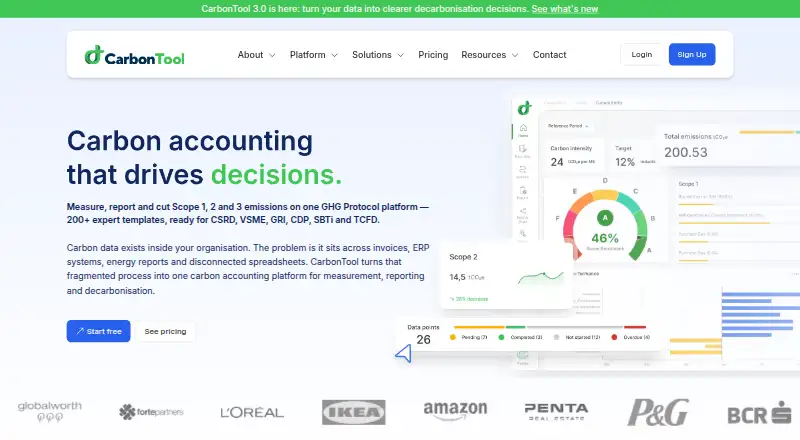
CarbonTool is a carbon accounting platform for measuring, reporting and reducing Scope 1, 2 and 3 emissions. Its website describes one data backbone for CSRD, VSME, GRI, CDP and ISSB reporting. Organizations can enter data manually or use Excel/CSV, AI uploads, API connections or SAF-T imports. More than 200 templates provide emission-source methodologies, units and factors; listed factor databases include DEFRA, EPA, ecoinvent and ADEME. CarbonTool can track subsidiaries, sites or business units separately, then consolidate them into a group inventory. It supports reduction targets and scenario planning that compares impact, cost and return. Each data point can carry its source, unit, factor, quality level and audit trail. Free Starter access covers Scope 1 and 2; paid plans add Scope 3 across all 15 GHG Protocol categories. Starter access lasts 30 days without a credit card or auto-charge, and trial data remains for 90 days after access lapses. The service is built and hosted in the EU.
Who it is for
It suits organizations that need emissions accounting across entities, reporting frameworks or supply chains. Starter is scoped to Scope 1 and 2, while paid plans provide Scope 3 coverage.
What is good
- More than 200 emission-source templates.
- Supports CSRD, VSME, GRI, CDP and ISSB.
- Tracks separate units and consolidates group inventories.
- EU-hosted emissions data under EU data protection law.
What to know first
- Starter covers only Scope 1 and 2.
- Paid plans start at €2,000 per year.
- MCP server access is on request.
Specifiction review
CarbonTool: the full review
CarbonTool combines emissions data collection, factor libraries, reporting and scenario planning. Check the Scope 3 and entity requirements against the chosen plan before committing.
CarbonTool is a carbon-accounting platform for organizations measuring emissions and preparing sustainability reports. It is most compelling for businesses with formal reporting duties or emissions spread across multiple entities. Its paid plans add full Scope 3 coverage and reporting options; Starter is limited to Scope 1 and 2.
Overview
CarbonTool brings emissions measurement, reporting and reduction planning together. Its reporting backbone supports CSRD, VSME, GRI, CDP and ISSB, while its audit trail records the source, unit, emission factor and quality level for each data point. That lineage is useful when figures need to be checked and explained, rather than accepted as a final total.
Organizations can track subsidiaries, sites or business units separately and consolidate them into a group inventory. This makes CarbonTool a stronger fit for companies with distributed operations than for a small, single-entity business that only needs a basic emissions record.
Key features
Measurement and data collection
More than 200 emission-source templates include methodology, measurement units and factors. CarbonTool includes DEFRA, EPA, ecoinvent and ADEME databases, and accepts data through manual entry, Excel or CSV, AI uploads, API connections and SAF-T imports. The breadth gives teams several routes to bring activity data into a consistent inventory, though it does not remove the work of collecting and checking that data.
CarbonTool supports Scope 1, 2 and 3 measurement, but full Scope 3 coverage across the 15 GHG Protocol categories is reserved for paid plans. Starter covers Scope 1 and 2, so it is not a route to a complete supply-chain inventory.
Reporting and reduction planning
The platform supports reduction targets and scenario planning that compares impact, cost and return. Those comparisons can help teams weigh proposed measures alongside reporting, rather than treating emissions accounting as an end in itself. Supplier engagement is supported, but the core distinction in the plans is the level of entity coverage and included reporting.
CarbonTool says emissions data remains on EU infrastructure under EU data protection law. Customers can connect systems through an API or MCP; MCP server access is on request.
Pricing
Starter costs 0.00 USD per free for 30 days of full access, with Scope 1 and 2 core measurement and no credit card required. Access then lapses; there is no auto-charge, and trial data is retained for 90 days afterward. It is a useful evaluation window, not an ongoing free tier.
Core costs 2000.00 USD per year, billed 2,000€/ year. It provides single-entity measurement, full platform access and 2 hours of monthly support. This is the entry paid option for a company with one entity that needs more than the limited Starter scope.
Pro costs 5000.00 USD per year, billed 5,000€/ year. It adds multi-unit tracking and consolidation, VSME reporting and 4 hours of monthly support. SMEs managing several entities or focusing on supply-chain coverage are the clearest fit.
Enterprise costs 7500.00 USD per year, billed 7,500€/ year. It targets large, multi-unit organizations and includes CSRD reporting, 6 hours of monthly support and priority support. It is the plan aimed at large organizations with CSRD obligations; its higher price is harder to justify for a single entity without that need.
All paid plans include full Scope 3 coverage across the 15 GHG Protocol categories. The Starter-to-Core step is therefore consequential for organizations that need supply-chain emissions, while Pro and Enterprise chiefly differentiate on organizational scale, included reporting and support.
Platforms
CarbonTool runs on web and offers an API. The API and MCP connection options suit organizations that need to connect emissions workflows to other systems; MCP access is on request.
Who it's for
Choose CarbonTool if your organization needs a traceable emissions inventory, recognized reporting frameworks and a path from measurement to reduction scenarios. Core suits single-entity companies; Pro is aimed at SMEs with multiple entities or supply-chain focus; Enterprise is positioned for large CSRD-obligated organizations. A business that only needs Scope 1 and 2 can try Starter, but should account for the 30-day limit.
Pros and cons
- Pros: Broad collection routes and more than 200 structured templates help accommodate varied emissions data sources.
- Pros: Data-point provenance and an audit trail support review of reported figures.
- Pros: Multi-entity consolidation, framework reporting and scenario planning cover distinct stages of emissions management.
- Cons: Starter excludes Scope 3 and expires after 30 days, limiting its value for ongoing or full-scope reporting.
- Cons: The entry paid plan is billed annually at 2,000€/ year, while multi-entity and CSRD-oriented features require more expensive plans.
Alternatives
Compare carbon accounting software if you want to weigh CarbonTool against a wider set of products.
- Greenio is worth considering if a freemium option is important: its free plan includes Scope 1, 2 and 3 tracking, AI recommendations and four PDF reports per year.
- Carbonfact may suit suppliers focused on environmental-data exchange, with free LCA verification and supplier-controlled data visibility.
- CO2 AI is an alternative if you want to try an enterprise platform free for 30 days and discuss pricing on request.
- Persefoni is another freemium option, with a free self-service plan for a single user.
- BigMile may be relevant if your work centers on large record volumes, API uploads and energy-shift scenarios.
- CarbonAnalytics offers a paid Starter plan at 69.99 GBP per month, billed per business unit, with up to 300 suppliers, one reporting framework and three users.
- CarbonChain is an alternative with a subscription fee set out in the customer’s order form or statement of work.
- ACT Group Decarbonization Platform is another web-based alternative.
Verdict
CarbonTool is a strong choice for organizations that need an auditable Scope 1–3 inventory, multi-entity consolidation and reporting tied to recognized frameworks. Its structured data collection and reduction scenarios make it more than a reporting endpoint. Look elsewhere if you need a durable free plan, or if your requirements stop at simple Scope 1 and 2 measurement and do not justify annual paid-plan costs.
CarbonTool plans and pricing
All plansCompared on carbon accounting software
- Free plan
- Nocarbontool.com
- Scope coverage
- scope 1-3carbontool.com
- Data collection
- bothcarbontool.com
- Emissions factors
- bothcarbontool.com
- Supplier engagement
- Yescarbontool.com
- Audit trail
- Yescarbontool.com
- API access
- Yescarbontool.com
Facts
- Purpose
- CarbonTool is a carbon accounting and sustainability platform for measuring, reporting and reducing Scope 1, 2 and 3 emissions.carbontool.com · 3 Oct 2026
- Reporting frameworks
- Its website says one data backbone supports reporting for CSRD, VSME, GRI, CDP and ISSB.carbontool.com · 3 Oct 2026
- Templates
- The platform offers 200+ built-in emission-source templates with methodology, measurement units and emission factors.carbontool.com · 3 Oct 2026
- Emission factors
- CarbonTool lists DEFRA, EPA, ecoinvent and ADEME as included emission-factor databases.carbontool.com · 3 Oct 2026
- Data imports
- The site lists manual entry, Excel/CSV, AI uploads, API connections and SAF-T import as ways to bring in emissions data.carbontool.com · 3 Oct 2026
- Multi-entity
- CarbonTool supports tracking subsidiaries, sites or business units separately and consolidating them into a group inventory.carbontool.com · 3 Oct 2026
- Decarbonisation
- The platform supports reduction targets and describes scenario planning with impact, cost and return comparisons.carbontool.com · 3 Oct 2026
- Free plan limit
- The free Starter covers Scope 1 and 2; all paid plans include full Scope 3 coverage across the 15 GHG Protocol categories.carbontool.com · 3 Oct 2026
- Trial terms
- Starter access lasts 30 days without a credit card, has no auto-charge, and trial data is retained for 90 days after lapse.carbontool.com · 3 Oct 2026
- Integration options
- CarbonTool says customers can connect systems through an API or MCP; its pricing page says MCP server access is on request.carbontool.com · 3 Oct 2026
- Security and residency
- The pricing page says CarbonTool is built and hosted in the EU and that emissions data stays on EU infrastructure under EU data protection law.carbontool.com · 3 Oct 2026
- Support
- The pricing page lists monthly support of 2 hours for Core, 4 for Pro, and 6 hours plus priority for Enterprise.carbontool.com · 3 Oct 2026
- Intended customers
- The site positions Core for single-entity companies, Pro for SMEs with multiple entities or supply-chain focus, and Enterprise for large CSRD-obligated organizations.carbontool.com · 3 Oct 2026
Company
- Headquarters
- Bucharest, Romaniacarbontool.com · 28 Sept 2026
Best CarbonTool alternatives
See all 20
Where it ranks on Specifiction
Is CarbonTool yours?
Claim it for free: prove the domain, then correct facts, plans and screenshots. An editor reviews every change.
Sources
- carbontool.com· checked 3 Oct 2026
- carbontool.com/platform/carbon-accounting/· checked 3 Oct 2026
- carbontool.com/pricing/· checked 3 Oct 2026