
CHAMELAION LipSync API
- 1Runs onAPI, Web
- 2CostsFree plan · free trial · paid from €5/mo
- 3Supported languages28 languages
- 4Voice cloningYes
- 5API accessYes
- 6Output resolution1080p
- 7Watermark-free outputYes
Overview
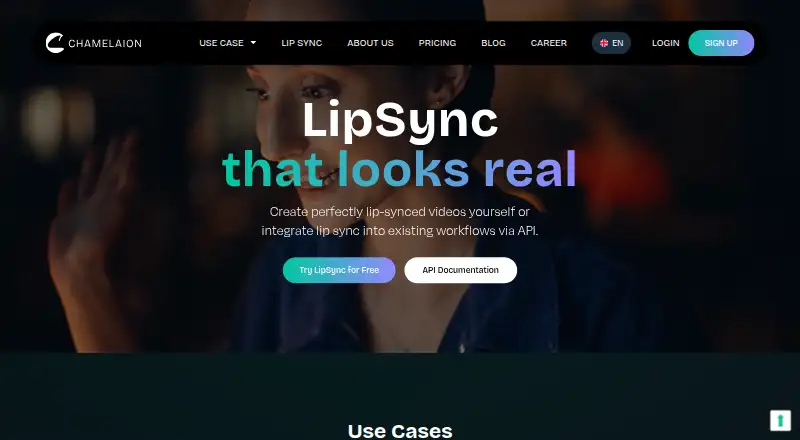
CHAMELAION LipSync API takes video and audio input and produces a video with lip movements matched to the audio. It accepts MP4 video and WAV or MP3 audio by public URL or direct upload. Active-speaker detection runs automatically but can be disabled for an individual request. The maker says the model retains speaker identity, speaking style, and expressions while adapting mouth movements to new audio. Listed uses include dubbing and translation, AI avatars, creative ads, and dialogue replacement or personalization. SDKs are listed for Python 3.8+ and TypeScript/Node.js 18+. Requests require a Bearer token or x-api-key header, except at the health endpoint; generation endpoints are limited to 60 requests per minute, and concurrent job limits depend on the plan. Starter is free and includes 24,000 tokens and two minutes of translation and lip sync, with a watermark. Basic costs €4.00 per year and lists 60,000 tokens and five minutes. The maker says its servers are in Europe and users retain ownership of generated videos. Profile views may work when the mouth remains visible; extreme close-ups, side views above 90 degrees, and cropped mouths are difficult cases.
Who it is for
The API may suit creators and organizations working on video dubbing, translation, AI avatars, or dialogue replacement. It is aimed at users who can provide supported video and audio inputs and work within plan-specific job limits.
What is good
- Accepts MP4 video and WAV or MP3 audio.
- Active-speaker detection can be disabled per request.
- SDKs are listed for Python and TypeScript/Node.js.
- Starter includes 24,000 tokens and two minutes.
What to know first
- Starter output has a watermark.
- Generation endpoints are limited to 60 requests per minute.
- Concurrent job limits depend on the plan.
- Cropped mouths and extreme angles are difficult cases.
Specifiction review
CHAMELAION LipSync API: the full review
CHAMELAION LipSync API specifies its accepted inputs, authentication, rate limit, and SDKs. Review the output constraints and plan limits, particularly if footage includes difficult face angles.
CHAMELAION LipSync API is a video lip-sync service for developers and teams working on dubbing, translation, avatars, or personalized dialogue. Its API controls and low-cost annual plans suit small, repeatable workflows; the brief translation quotas and difficult-angle limits make it a weaker fit for sustained volume or challenging footage.
Overview
The service takes MP4 video and WAV or MP3 audio, supplied by public URL or direct upload, and generates a video with lip movements matched to the audio. It is available through an API and the web. CHAMELAION says its model preserves a speaker’s identity, speaking style, and expressions while adapting the mouth movements.
Automatic active-speaker detection can be disabled per request, useful when a workflow needs to control how multi-speaker clips are handled. Generation endpoints allow 60 requests per minute, but concurrent jobs vary by plan, so that request rate alone does not establish processing capacity.
Key features
- Developer access: Authentication uses a Bearer token or x-api-key header, except for the health endpoint. SDKs support Python 3.8+ and TypeScript/Node.js 18+, giving teams in those environments a direct integration path.
- Video constraints: Output resolution is 1080p, and the service supports voice cloning. Profile views can work when the mouth remains sufficiently visible, but extreme close-ups, side views beyond 90 degrees, and cropped mouths are difficult cases. It is a better match for footage with a clear view of the speaker than for tightly framed or highly oblique shots.
- Languages and usage: The supported-language count is 28. CHAMELAION describes translation into 30 languages, so confirm that the required language pair is covered before building a workflow around it.
- Data and rights: CHAMELAION says its servers are hosted in Europe and its subcontractors comply with GDPR or have signed Data Processing Agreements. Users retain ownership of generated videos; the company says it processes content for translation and dubbing.
Pricing
The plans pair token allowances with video-translation minutes, but the paid tiers do not all include the same lip-sync terms. Compare the stated allowance and video-length limits with the specific job before choosing a plan.
- Starter — 0.00 EUR per free: 24,000 tokens, stated as 2 minutes of video translation plus lip sync. Output carries a watermark; no credit card is required. This is a small no-card way to assess a workflow, not a substantial free production allowance.
- Basic — 4.00 EUR per year, billed Yearly: 60,000 tokens, equal to 5 minutes of video translation/lipsync, with videos of any size and length and no watermark. Its low annual price is appealing for light use, but five minutes is a tight quota.
- Bronze — 20.00 EUR per year, billed Yearly: 60,000 tokens and 5 minutes of video translation, a stated 60-minute video-length limit, and extra tokens available. This adds room for longer source videos and quota top-ups, but the plan description states translation minutes rather than a lip-sync allowance.
- Silver — 96.00 EUR per year, billed Yearly: 60,000 tokens and 5 minutes of video translation, plus 3 seats, a glossary, priority support, and SRT upload. It suits a small team that needs those collaboration and translation features; the same short stated minute allowance remains.
- Gold — 500.00 EUR per month, billed Monthly: 60,000 tokens and 5 minutes of video translation/lipsync, with 5 seats, glossary, priority support, and SRT upload. It offers the team features without an annual term, but the price is steep relative to the stated five-minute allowance.
- Enterprise — custom pricing: Individual pricing and tokens, premium support, and a custom contract suit organizations that need terms beyond the listed tiers.
Basic, Bronze, and Silver are billed yearly; Gold is billed monthly. No renewal terms are stated.
Platforms
CHAMELAION supports API and web access. The documented SDKs target Python 3.8+ and TypeScript/Node.js 18+, which makes it a practical fit for teams already using those runtimes, rather than a ready-made mobile-app workflow.
Who it's for
This is best for developers and small teams automating dubbing, translation, avatar speech, creative ads, or dialogue replacement who can work within short per-plan allowances and supply footage with visible mouths. European hosting and the stated subcontractor arrangements may matter to organizations evaluating data handling. It is less suitable for high-volume production on the listed tiers or footage dominated by extreme angles and close-ups.
Pros and cons
- Pro: URL or upload input, automatic speaker detection with a per-request switch, and SDKs for Python and TypeScript/Node.js support configurable integrations.
- Pro: Basic includes watermark-free output and videos of any size and length for 4.00 EUR per year, making it an inexpensive entry point for light work.
- Pro: Silver and Gold add seats, glossary, SRT upload, and priority support for teams with translation workflows.
- Con: The stated five-minute allowance on paid tiers limits how much work the low headline prices cover.
- Con: Extreme close-ups, side angles above 90 degrees, and cropped mouths are difficult, restricting the footage it can handle reliably.
- Con: Concurrent-job limits depend on plan, so teams cannot infer throughput from the 60-requests-per-minute rate alone.
Alternatives
AI Video Lip Sync Tools is a useful starting point for comparing services in the category.
- VEED is worth considering for readers who want Android, iOS, or browser-extension access alongside web; its free plan exports at 720p with a watermark.
- LipDub is another API-and-web freemium option with a free tier and trial; its Seed plan includes one minute at 1080p with a watermark, plus AI dubbing, voice cloning, and lip sync.
- Sync Labs offers an API-and-web free tier with three generations per month, capped at 20 seconds each, for readers whose needs fit short tests.
- lipsyn.cc offers a five-second preview without sign-up or a card, and a one-time Quick Take purchase displayed at €6.99 for five minutes; it may suit a single short job better than a recurring plan.
- Morph Studio is a web-based alternative for readers seeking a broader video and image creation toolset.
- WeryAI Video Lip Sync supports Android, iOS, and web, for readers who prefer mobile access.
- Rendley is an API-and-web freemium alternative with no free trial; its operator is identified as Onix Technologies SRL in Moldova.
- EchoMimic is a free project with Linux, web, and self-hosted options for readers seeking those deployment choices.
Verdict
Choose CHAMELAION LipSync API for a developer-led dubbing or translation workflow that needs configurable speaker detection, 1080p output, and an inexpensive watermark-free entry plan. The main reasons to look elsewhere are the five-minute paid-tier allowances and the model’s difficulty with extreme angles or cropped mouths; neither low annual pricing nor a high request rate removes those constraints.
CHAMELAION LipSync API plans and pricing
All plansCompared on AI video lip sync tools
- Free plan
- Yeschamelaion.com
- Supported languages
- 28 languageschamelaion.com
- Voice cloning
- Yeschamelaion.com
- API access
- Yeschamelaion.com
- Output resolution
- 1080pchamelaion.com
- Watermark-free output
- Yeschamelaion.com
Facts
- Purpose
- The API takes video and audio input and generates a new video with lip movements matched to the audio.docs.chamelaion.com · 30 Sept 2026
- Use cases
- The maker lists video dubbing and translation, AI avatars, UGC and creative ads, and dialogue replacement or personalization as use cases.chamelaion.com · 30 Sept 2026
- Input
- The API accepts MP4 video and WAV or MP3 audio via public URLs or direct upload.docs.chamelaion.com · 30 Sept 2026
- Speaker detection
- Active speaker detection is automatic and can be disabled per request.docs.chamelaion.com · 30 Sept 2026
- Identity and style
- The maker says its lip-sync model preserves speaker identity, speaking style, and expressions while matching lip movements to new audio.docs.chamelaion.com · 30 Sept 2026
- API limits
- Generation endpoints have a rate limit of 60 requests per minute, and maximum concurrent jobs depend on the plan.docs.chamelaion.com · 30 Sept 2026
- Developer support
- The API documentation lists SDKs for Python 3.8+ and TypeScript/Node.js 18+.docs.chamelaion.com · 30 Sept 2026
- Security
- API requests require authentication by Bearer token or x-api-key header, except for the health endpoint.docs.chamelaion.com · 30 Sept 2026
- Privacy and hosting
- CHAMELAION says its servers are hosted in Europe and that its subcontractors comply with GDPR or have signed Data Processing Agreements.chamelaion.com · 30 Sept 2026
- Content ownership
- CHAMELAION says users retain full ownership of generated videos and that the company processes content for translation and dubbing purposes.chamelaion.com · 30 Sept 2026
- Support
- The pricing page lists priority support on Silver and Gold and premium support on Enterprise.chamelaion.com · 30 Sept 2026
- Input constraints
- The product page says LipSync handles profile views when the mouth remains sufficiently visible; extreme close-ups, extreme side views above 90 degrees, and cropped mouths are listed as difficult scenarios.chamelaion.com · 30 Sept 2026
- Intended users
- The company describes its platform as serving creators, businesses, and organizations, and says it supports audio and video translation into 30 languages.chamelaion.com · 30 Sept 2026
Company
- Headquarters
- The imprint lists CHAMELAION GmbH at Berger Straße 342, 60385 Frankfurt am Main, Germany.chamelaion.com · 30 Sept 2026
Best CHAMELAION LipSync API alternatives
See all 20
Where it ranks on Specifiction
Is CHAMELAION LipSync API yours?
Claim it for free: prove the domain, then correct facts, plans and screenshots. An editor reviews every change.
Sources
- docs.chamelaion.com· checked 30 Sept 2026
- chamelaion.com/lip-sync· checked 30 Sept 2026
- docs.chamelaion.com/guides/authentication· checked 30 Sept 2026
- chamelaion.com/use-case/corporate-internal-communicati· checked 30 Sept 2026
- chamelaion.com/plans· checked 30 Sept 2026
- chamelaion.com/about-us· checked 30 Sept 2026
- chamelaion.com/imprint· checked 30 Sept 2026