django CMS
- 1Runs onAPI, Linux, self-hosted, Web, Windows
- 2CostsFree plan · paid from $2/mo
- 3Platform typeself hosted
- 4Editorial workflowsYes
- 5Custom user rolesYes
- 6Multilingual contentYes
- 7SEO toolsYes
- 8Media libraryYes
Overview
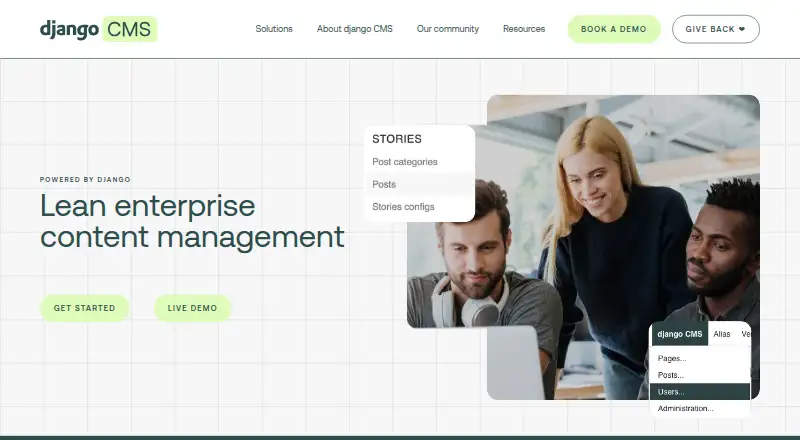
django CMS is an open-source content management system built on Django for creating and managing websites. Editors can change content directly on the page, while a drag-and-drop builder arranges reusable components such as text, images, videos, forms, and custom business elements. The system supports multiple languages and multi-site publishing, with SEO tools, a media library, custom content types, editorial workflows, and custom user roles. Permissions include granular privileges and separate editor and publisher roles. Developers can integrate existing Django applications through application views and placeholders. Deployment can use traditional Django rendering, hybrid rendering with a REST API, or headless delivery through REST endpoints; headless mode and the REST API are available through the djangocms-rest add-on. The core CMS is free and open, with no license fees. It is self-hosted and supports web, Linux, Windows, and API contexts. Installation requires Python 3.10 or later and uses pip. The maker, based in Zurich, Switzerland, was founded in 2007 and identifies enterprises, universities, and digital agencies as intended users.
Who it is for
django CMS suits enterprises, universities, and digital agencies building content-rich websites. It is especially relevant to teams using Django applications, multilingual content, or multi-site publishing.
What is good
- Free open-source core with no license fees.
- Visual frontend editing and drag-and-drop layouts.
- Supports multilingual content and multi-site publishing.
- Includes editorial workflows and custom user roles.
- Integrates existing Django applications.
What to know first
- Headless mode and REST API use an add-on.
- Analytics integrations rely on third-party packages or services.
- Hosting sandboxes and automated backups are not built in.
- Installation requires Python 3.10 or later.
Verdict
django CMS combines visual editing and reusable page components with Django application integration. Teams should account for the add-on requirement for headless delivery and for hosting and other listed capabilities that sit outside the core.
django CMS plans and pricing
All plansCompared on content management systems
- Free plan
- Yesdjango-cms.org
- Platform type
- self_hosteddjango-cms.org
- Editorial workflows
- Yesdjango-cms.org
- Custom user roles
- Yesdjango-cms.org
- Multilingual content
- Yesdjango-cms.org
- SEO tools
- Yesdjango-cms.org
- Media library
- Yesdjango-cms.org
- Custom content types
- Yesdjango-cms.org
Facts
- What it does
- django CMS is an open-source content management system built on the Django web framework.django-cms.org · 7 Oct 2026
- Editing
- Editors can change content directly on the page using visual frontend editing.django-cms.org · 7 Oct 2026
- Page building
- The page builder supports drag-and-drop layouts and reusable content components.django-cms.org · 7 Oct 2026
- Languages
- It supports managing content in multiple languages from one platform.django-cms.org · 7 Oct 2026
- Permissions
- The feature list includes granular privileges, and the product page lists editor and publisher permissions.django-cms.org · 7 Oct 2026
- Django integrations
- Existing Django apps can be integrated, including through application views and placeholders.django-cms.org · 7 Oct 2026
- Headless
- The feature list marks headless mode and a REST API as available through the djangocms-rest add-on.django-cms.org · 7 Oct 2026
- Security
- The feature list says django CMS has passed security audits and includes granular privileges, SSL, and session management.django-cms.org · 7 Oct 2026
- Security reporting
- The support page asks users to report code security issues privately by email and not in a public forum.django-cms.org · 7 Oct 2026
- Not built in
- The feature list marks analytics, third-party authentication, and digital asset management integrations as available through third-party packages or services.django-cms.org · 7 Oct 2026
- Support
- Community support includes technical documentation, Stack Overflow, Discord, GitHub Issues, and an AI chat service.django-cms.org · 7 Oct 2026
- Intended users
- The maker says it serves enterprises, universities, and digital agencies building scalable, content-rich web experiences.django-cms.org · 7 Oct 2026
- License and cost
- The Association says django CMS is free and open, and that it charges no license fees.django-cms.org · 7 Oct 2026
- Hosting
- The feature list says development sandboxes and automated backups are part of a hosting solution rather than built into the CMS.django-cms.org · 7 Oct 2026
- Purpose
- django CMS is an open-source content management system built on Django for creating and managing websites.docs.django-cms.org · 7 Oct 2026
- Reusable content
- Its plugin architecture lets developers create reusable content components, including text, images, videos, forms, and custom business components.django-cms.org · 7 Oct 2026
- Languages and sites
- The product supports multilingual content management and multi-site publishing.django-cms.org · 7 Oct 2026
- Deployment modes
- The documented architectures include traditional Django rendering, hybrid rendering with a REST API, and headless delivery through REST endpoints.django-cms.org · 7 Oct 2026
- Integrations
- django CMS can integrate custom Django applications, while add-ons provide capabilities such as rich-text editing, Bootstrap 5 components, media management, versioning, and reusable content blocks.docs.django-cms.org · 7 Oct 2026
- Limits and add-ons
- Approval workflows, spell checking, and digital asset management integrations are listed as available through third-party packages or services rather than built into the core.django-cms.org · 7 Oct 2026
- Installation
- The install tutorial requires Python 3.10 or later and documents installation with pip and a command that creates a configured project.docs.django-cms.org · 7 Oct 2026
Company
- Founded
- 2007django-cms.org · 28 Sept 2026
- Headquarters
- Zurich, Switzerlanddjango-cms.org · 28 Sept 2026
Best django CMS alternatives
See all 20


Where it ranks on Specifiction
Is django CMS yours?
Claim it for free: prove the domain, then correct facts, plans and screenshots. An editor reviews every change.
Sources
- django-cms.org/about-django-cms/detailed-feature-list/· checked 7 Oct 2026
- django-cms.org/about-django-cms/features/· checked 7 Oct 2026
- django-cms.org/resources/support/· checked 7 Oct 2026
- django-cms.org/community/memberships/· checked 7 Oct 2026
- docs.django-cms.org/en/stable/· checked 7 Oct 2026
- django-cms.org/developers/· checked 7 Oct 2026
- docs.django-cms.org/en/stable/tutorials/00-installing-djang· checked 7 Oct 2026
- django-cms.org· checked 28 Sept 2026