
- 1Runs onAndroid, API, Browser, Web
- 2CostsFree plan
- 3Media typesimages, video
- 4API accessYes
- 5Face analysisYes
- 6Real-time analysisNo
- 7Maximum file size100 MB
Overview
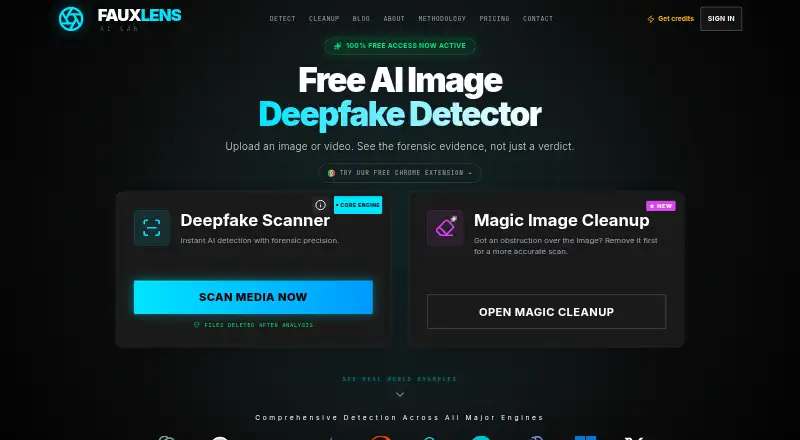
FauxLens analyzes images and video for signs of AI generation or manipulation, returning a verdict, confidence score, and forensic evidence. Its six-signal engine uses ELA, PRNU, GAN fingerprints, FFT, shadow physics, and EXIF forensics. Listed detection coverage includes OpenAI, Midjourney, Stability, Gemini, Firefly, Flux.1, Canva AI, Ideogram, Bing, and Grok. Image cleanup tools remove unwanted people, visual noise, and platform overlays. The web tool accepts JPG, PNG, and WebP images, and cleanup exports retain original dimensions up to 4K. A Chrome extension can scan publicly accessible images via right-click, but cannot scan images requiring authentication or blocked by cross-origin policy. The REST API accepts image or video files, or a URL, and returns structured JSON with verdict, confidence, and evidence by layer. API keys are limited to 20 requests per minute per key and 30 per minute per account; file requests are capped at 25MB and URL fetches at 50MB. FauxLens says uploaded media is deleted after analysis and scan history remains in the browser. Free includes 40 credits, described as four detections; one-time plans start at $2.99. API verdicts are informational, not proof or a sole basis for consequential decisions.
Who it is for
It suits journalists, HR teams, researchers, and others assessing whether media may be authentic. Developers can use the API, provided they treat its verdict as informational rather than proof or the sole basis for consequential decisions.
What is good
- Returns a verdict, confidence score, and evidence
- Six listed forensic detection signals
- Web tool accepts JPG, PNG, and WebP
- API supports image, video, and URL inputs
- Free plan includes 40 credits
What to know first
- Chrome extension cannot scan some restricted images
- API has per-minute request limits
- API requests have file-size caps
- Verdicts are not proof for consequential decisions
Specifiction review
FauxLens: the full review
FauxLens offers image and video checks through web, extension, and API options, with listed limits on extension access and API requests. Its documentation cautions against treating a verdict as proof or using it alone for consequential decisions.
FauxLens is a media-authenticity checker with image cleanup, browser extension and API options. It is best suited to occasional checks or developer workflows that benefit from forensic evidence alongside a verdict. Its one-time credit packs keep costs predictable, but the results are not proof and should not decide consequential cases on their own.
Overview
FauxLens analyzes images and video for signs of AI generation or manipulation, returning a verdict, confidence score and evidence from its forensic checks. Its six-signal approach combines ELA, PRNU, GAN fingerprints, FFT, shadow physics and EXIF forensics. It names generators including OpenAI, Midjourney, Stability, Gemini, Firefly, Flux.1, Canva AI, Ideogram, Bing and Grok. That breadth is useful for an initial screen, but a confidence score and evidence chain still need human judgment.
Image cleanup tools remove unwanted people, visual noise and platform overlays. The site says uploaded media is processed in an isolated environment and deleted after analysis, with scan history kept in the user's browser. This is a sensible privacy distinction for users handling sensitive material, although it does not make a detection verdict conclusive.
Key features
Image and video checks
The web tool accepts JPG, PNG and WebP images. Cleanup exports retain original dimensions up to 4K, which helps when an edit should preserve source resolution. FauxLens also supports video, but it does not provide real-time analysis, so it is not suited to workflows that require an immediate, continuous decision.
Extension and API
The Chrome extension starts a scan from a right-click on a publicly accessible image. It cannot reach images behind authentication or blocked by cross-origin policy, limiting its usefulness on some sites.
The REST API accepts image or video files, or a URL, and returns structured JSON with a verdict, confidence score and per-layer evidence chain. That makes it a more natural fit than manual checks for moderation pipelines, ATS tools such as Greenhouse and Lever, social platforms, WordPress or Contentful integrations. Keys are limited to 20 requests per minute, with an account-wide limit of 30 per minute. Requests can include files up to 25 MB; URL fetches are capped at 50 MB. The product's maximum file size is 100 MB, but those API-specific caps are the practical constraint for API users. FauxLens warns that the API verdict is informational, not proof, and must not be the sole basis for consequential decisions.
Pricing
The free plan costs 0.00 USD per free and includes 40 credits, described as four detections, with the full six-signal pipeline and no credit card requirement. It is enough to try the core checks, but the small allowance is only a starting point for recurring use. There is no free trial.
Paid plans are one-time payments, not recurring subscriptions, and their credits never expire:
- Starter: 2.99 USD per once for 500 credits, about 50 image scans. Best for occasional personal use; it gives up the larger reserve of higher tiers.
- Pro: 9.99 USD per once for 2,000 credits, about 200 image scans. A better fit for repeated project work without committing to a subscription.
- Max: 19.99 USD per once for 5,000 credits, about 500 image scans. This suits heavier intermittent use, though the stated scan estimates are for images.
The non-expiring credits favor sporadic work over a monthly allowance that might go unused. No seat limits are stated for these packs.
Platforms
FauxLens runs on Android, the web, a Chrome extension and an API. That range covers individual browser use and integration work, but the extension's access restrictions remain relevant when scanning web images.
Who it's for
Journalists, HR teams, researchers and others assessing whether media is authentic are the stated audience. The API also makes sense for developers adding an initial media check to an existing workflow. FauxLens is a poor fit when an organization needs a definitive finding for hiring, moderation or another high-stakes decision, or when analysis must happen in real time.
Pros and cons
- Pro: Six forensic signals and per-layer API evidence offer more context than a bare AI-or-human label.
- Pro: One-time packs with credits that never expire suit occasional use and avoid recurring charges.
- Pro: Image cleanup sits alongside detection, and exports preserve original dimensions up to 4K.
- Con: The free allowance is just four detections, so regular use means buying credits.
- Con: The extension cannot scan authenticated or cross-origin-blocked images.
- Con: API rate and file-size caps constrain automated workloads, and the verdict is explicitly not proof.
Alternatives
AI Deepfake Detection Tools is the broader category list for readers who want to compare options.
- Netarx is worth considering if voice and email protection matter alongside video protection, or if you need iOS, macOS or Windows support.
- ForgeSpy is another freemium option with Android, iOS and web access; its free signup includes five credits, with one credit per image scan.
- Unreveal is an alternative for readers seeking a paid service with Linux, macOS, Windows, web and API platforms.
- Deepfake Detector may fit users who want a free monthly allowance of 50 detections, voice and video checks up to two minutes, and a TrustScore.
- Hive AI-Generated Content Detection is a developer-facing alternative with access to more than 10 models and pay-as-you-go selected models; its free credits require adding a payment method.
- Reality Defender offers a free API plan with 50 scans per month, up to three seats, image and audio analysis, API keys and an analytics dashboard.
- Sensity AI is a paid alternative with a free trial.
- DuckDuckGoose DeepDetector is another paid option with a free plan and free trial.
Verdict
Choose FauxLens for occasional image or video authenticity checks when you want forensic context, optional cleanup and credits that do not expire. Its API is useful for integrating structured results, but the extension has access limits and the rate caps bound automation. Look elsewhere if you need real-time analysis or a verdict that can serve as proof: FauxLens itself says its result should not be the sole basis for consequential decisions.
FauxLens plans and pricing
All plansCompared on AI deepfake detection tools
- Free plan
- Yesfauxlens.com
- Media types
- images, videofauxlens.com
- API access
- Yesfauxlens.com
- Face analysis
- Yesfauxlens.com
- Real-time analysis
- Nofauxlens.com
- Maximum file size
- 100 MBfauxlens.com
Facts
- Product
- FauxLens detects AI-generated and manipulated images and video, returning a verdict, confidence score, and forensic evidence.fauxlens.com · 28 Sept 2026
- Detection signals
- Its six-signal engine includes ELA, PRNU, GAN fingerprints, FFT, shadow physics, and EXIF forensics.fauxlens.com · 28 Sept 2026
- Supported generators
- The homepage lists OpenAI, Midjourney, Stability, Gemini, Firefly, Flux.1, Canva AI, Ideogram, Bing, and Grok among the engines it detects.fauxlens.com · 28 Sept 2026
- Image cleanup
- The cleanup tools remove unwanted people, visual noise, and platform overlays from images.fauxlens.com · 28 Sept 2026
- Privacy
- The site says uploaded media is processed in an isolated environment, deleted after analysis, and not stored; scan history stays in the user's browser.fauxlens.com · 28 Sept 2026
- Supported web formats
- The web tool accepts JPG, PNG, and WebP images, and the site says cleanup exports retain original dimensions up to 4K.fauxlens.com · 28 Sept 2026
- Chrome extension
- The Chrome extension lets users right-click publicly accessible images to run a scan, but cannot scan images requiring authentication or blocked by cross-origin policy.fauxlens.com · 28 Sept 2026
- API
- The REST API accepts image files, video files, or a URL and returns structured JSON with a verdict, confidence score, and per-layer evidence chain.fauxlens.com · 28 Sept 2026
- API limits
- Developer API keys are limited to 20 requests per minute per key and 30 per minute per account; each request is capped at 25MB, while URL fetches are capped at 50MB.fauxlens.com · 28 Sept 2026
- API integrations
- The developer page describes integration patterns for moderation pipelines, ATS tools including Greenhouse and Lever, social platforms, WordPress, and Contentful.fauxlens.com · 28 Sept 2026
- Support
- The site lists [email protected] as its support contact.fauxlens.com · 28 Sept 2026
- Intended users
- The about page says FauxLens is built for journalists, HR teams, researchers, and others who need to assess whether media is authentic.fauxlens.com · 28 Sept 2026
- Use limitation
- The API documentation says a verdict is informational and should not be treated as proof or used as the sole basis for consequential decisions.fauxlens.com · 28 Sept 2026
Company
- Founded
- 2026fauxlens.com · 28 Sept 2026
- Headquarters
- Palm Beach Gardens, Florida, United Statesfauxlens.com · 28 Sept 2026
Best FauxLens alternatives
See all 19



Where it ranks on Specifiction
Is FauxLens yours?
Claim it for free: prove the domain, then correct facts, plans and screenshots. An editor reviews every change.
Sources
- fauxlens.com· checked 28 Sept 2026
- fauxlens.com/chrome-extension· checked 28 Sept 2026
- fauxlens.com/developers· checked 28 Sept 2026
- fauxlens.com/about· checked 28 Sept 2026
- fauxlens.com/pricing· checked 28 Sept 2026