
- 1Runs onAPI, Linux, self-hosted, Web
- 2CostsFree plan
- 3Online storeYes
- 4Offline storeYes
- 5Point-in-time joinsYes
- 6Feature monitoringYes
- 7Deployment modelboth
- 8Serving modesboth
Overview
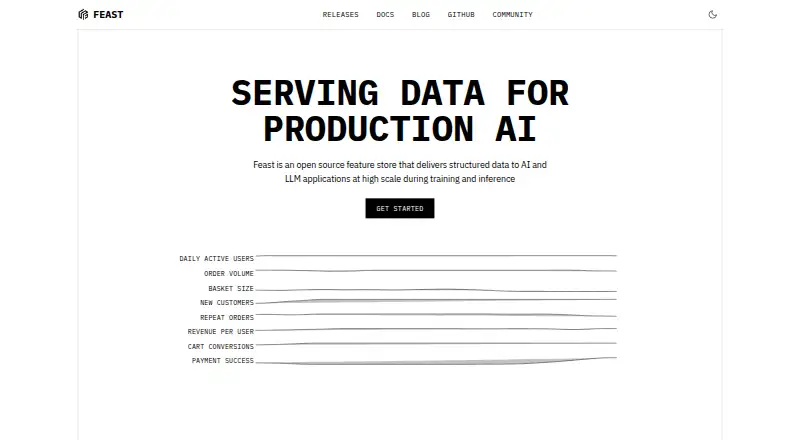
Feast is an open-source feature store for delivering structured data to AI and LLM applications during training and inference. It manages machine-learning features for batch and real-time use, with online and offline stores. Point-in-time joins keep future feature values out of training datasets. Feature services help teams discover, collaborate on, and version feature sets. The Python SDK and CLI manage version-controlled definitions, materialize values, build training datasets, and retrieve online features. Feast’s Python feature server exposes features through an HTTP endpoint with JSON input and output, so clients in any language that can make HTTP requests can use it. Integrations cover data sources and stores, including community and custom options. Feast can run on Kubernetes, with feature servers and scheduled or ad-hoc jobs deployed as workloads. It supports OIDC and Kubernetes RBAC authorization, but defaults to no_auth and leaves authentication-token handling to clients. Batch transformations require a separate transformation engine. Feast is free and open source.
Who it is for
Feast suits data scientists, MLOps engineers, data engineers, and AI engineers managing features for model training and inference. Its Kubernetes deployment option may suit teams running feature services and jobs as Kubernetes workloads.
What is good
- Supports batch and real-time feature serving
- Point-in-time joins help prevent training data leakage
- Python SDK and CLI manage feature workflows
- HTTP feature server accepts JSON input and output
- Free and open source
What to know first
- Default authorization is no_auth
- Clients must manage and pass authentication tokens
- Batch transformations need a separate engine
- Spark stream processor is experimental
Verdict
Feast covers feature management and serving across batch and real-time workloads, with point-in-time joins and multiple integration options. Teams should account for client-managed authentication and the separate engine required for batch transformations.
Feast plans and pricing
All plansCompared on feature store software
Facts
- What it does
- Feast is an open-source feature store that delivers structured data to AI and LLM applications for training and inference.feast.dev · 30 Sept 2026
- Batch and real-time
- Feast supports machine learning feature management and serving for both batch and real-time applications.docs.feast.dev · 30 Sept 2026
- Point-in-time correctness
- Feast joins feature tables using point-in-time logic to prevent future feature values from leaking into model training data.docs.feast.dev · 30 Sept 2026
- Feature versioning
- Feast enables discovery and collaboration on existing features and versioning of feature sets through feature services.docs.feast.dev · 30 Sept 2026
- SDK and CLI
- The Python SDK and CLI manage version-controlled feature definitions, materialize values, build training datasets, and retrieve online features.docs.feast.dev · 30 Sept 2026
- Feature server
- The Python feature server serves features through an HTTP endpoint with JSON input and output, usable from any language that can make HTTP requests.docs.feast.dev · 30 Sept 2026
- Stores and sources
- Feast docs describe integrations with offline and online stores and data sources, including community and custom integrations.docs.feast.dev · 30 Sept 2026
- Stream processing
- Feast's component overview describes an experimental Spark processor that can consume data from Kafka.docs.feast.dev · 30 Sept 2026
- Deployment
- Feast can be deployed on Kubernetes, where feature servers and scheduled or ad-hoc jobs can run as Kubernetes workloads.docs.feast.dev · 30 Sept 2026
- Access control
- Feast supports OIDC and Kubernetes RBAC authorization, while its default authorization configuration is no_auth.docs.feast.dev · 30 Sept 2026
- Authentication responsibility
- Feast does not provide authentication capabilities; clients are responsible for managing and passing authentication tokens to the server.docs.feast.dev · 30 Sept 2026
- Transformations
- The architecture docs say Feast supports transformations for on-demand and streaming sources, while batch transformations require a separate transformation engine.docs.feast.dev · 30 Sept 2026
- Intended users
- The quickstart identifies data scientists, MLOps engineers, data engineers, and AI engineers as users Feast is designed to serve.docs.feast.dev · 30 Sept 2026
- Community support
- The Feast homepage invites users to join its Slack community for support from Feast developers.feast.dev · 30 Sept 2026
Best Feast alternatives
See all 16

Where it ranks on Specifiction
Is Feast yours?
Claim it for free: prove the domain, then correct facts, plans and screenshots. An editor reviews every change.
Sources
- feast.dev· checked 30 Sept 2026
- docs.feast.dev/getting-started/quickstart· checked 30 Sept 2026
- docs.feast.dev/getting-started/components/overview· checked 30 Sept 2026
- docs.feast.dev/reference/feature-servers/python-featur· checked 30 Sept 2026
- docs.feast.dev/getting-started/third-party-integration· checked 30 Sept 2026
- docs.feast.dev/how-to-guides/feast-on-kubernetes· checked 30 Sept 2026
- docs.feast.dev/getting-started/components/authz_manage· checked 30 Sept 2026
- docs.feast.dev/getting-started/architecture/overview· checked 30 Sept 2026