
- 1Runs onAndroid, iOS, Linux, Mac, Web, Windows
- 2CostsFree plan · paid from $0.42/mo
- 3Supported platformsAndroid, iOS, Windows, macOS, Linux
- 4Web interfaceYes
Overview
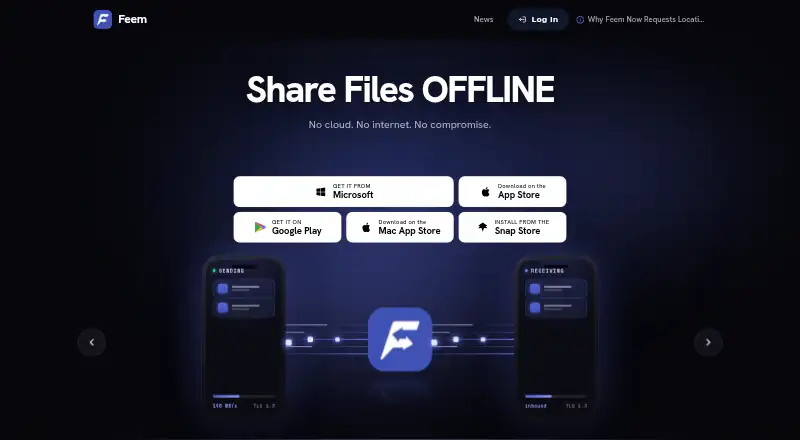
Feem transfers files directly between nearby devices, keeping transfers on a local network rather than routing them through the Internet. Devices can connect through shared Wi-Fi, a hotspot, or Wi-Fi Direct, including without Internet access. Feem discovers devices on the same network automatically and assigns random names by default. It supports sending and receiving at the same time, and includes chat; messages are deleted after 48 hours. The maker says local transfers use TLS 1.3 encryption and files stay on the local network. Feem pushes files from the sending device and says it does not pull files or expose the whole file system by default. Its privacy policy says it does not store chat history or see shared files. Devices must be near each other on the same local network, and the app needs to stay in the foreground during transfers. Feem is available on Android, iOS, Linux, macOS, web, and Windows. The free plan costs 0.00 USD per free and includes unlimited file transfers. Paid plans start at 4.99 USD per year.
Who it is for
Feem suits people who need to transfer files between nearby devices, including at home, school, work, or where Internet access is unreliable. It is not suited to sending files to someone in another city.
What is good
- Transfers work over Wi-Fi without Internet access.
- Devices are discovered automatically on the same network.
- Supports simultaneous sending and receiving.
- Includes chat with messages deleted after 48 hours.
- Free plan includes unlimited file transfers.
What to know first
- Devices must be near each other on the same network.
- Transfers require Feem to stay in the foreground.
- Mobile systems may interrupt background transfers.
Specifiction review
Feem: the full review
Feem offers local transfers across a broad set of platforms, with a free plan for unlimited file transfers. Its reliance on nearby devices and foreground operation is important to weigh before choosing it.
Overview
Feem is a local file-transfer app for people who need to move files between nearby devices, including where Internet access is unreliable. It is strongest for exchanging files across your own devices or with people in the same place; it is not a remote-sharing service. The foreground requirement also makes it a poor choice for transfers that need to run unattended.
Key features
Feem keeps transfers on the local network, connecting devices through shared Wi-Fi, a hotspot, or Wi-Fi Direct. Devices on the same network are discovered automatically and assigned random names, which simplifies discovery but can make it harder to identify a particular device. The Personal plan adds custom device names and download locations.
Full-duplex operation lets both devices send and receive at once, useful when people are exchanging files in both directions. Feem also includes chat, with messages automatically deleted after 48 hours. Feem says transfers use TLS 1.3 encryption and files remain on the local network. Its push-based design sends files from the sender rather than pulling them or exposing the whole file system by default; the privacy policy says Feem does not retain chat history or see shared files.
The local-only design sets a firm boundary: devices must be near one another on the same network, so Feem cannot send a file to someone in another city. Both devices also need Feem in the foreground during a transfer. Mobile operating systems may interrupt background activity, making the app less suitable for long transfers that need no attention.
Pricing
The free plan costs 0.00 USD per free and allows unlimited file transfers. It is the sensible starting point for users who can accept ads and do not need the paid support or customization features.
- Feem Pro iOS: 4.99 USD per year, manually renewed each year and not automatically billed. It covers iPhones and iPads, all devices linked to the Apple ID, unlimited transfers, no ads, and medium-priority email support.
- Feem Pro Personal: 9.99 USD per year, manually renewed and not automatically billed. It covers 1–4 devices, excluding iPhones and iPads, with unlimited transfers, no ads, custom device names and download locations, and medium-priority email support.
- Feem Pro Family: 49.99 USD per year, manually renewed and not automatically billed. It covers 5–19 devices, excluding iPhones and iPads, with unlimited transfers, no ads, and high-priority email support.
- Feem Pro Business: 499.99 USD per year, manually renewed and not automatically billed. It covers 20–100 devices, excluding iPhones and iPads, with unlimited transfers, no ads, and highest-priority email support.
Each paid tier is an annual manual renewal rather than an automatic charge. The iOS plan is the relevant paid option for Apple mobile devices; the other device-count plans exclude iPhones and iPads. Larger tiers mainly add capacity and higher-priority email support, while only Personal explicitly adds customization.
Platforms
Feem supports Android 10+, iOS, Windows 10 and 11, macOS, and Linux distributions including Ubuntu and Fedora. A web interface is also available. This breadth helps when a local group uses mixed desktop and mobile systems, though the foreground transfer requirement remains relevant on mobile devices.
Who it's for
Feem suits households, classrooms, workplaces, and groups in remote or crisis areas that need to exchange files locally without dependable Internet access. Its unlimited free transfers make it practical for occasional or repeated local sharing. Choose something else for sending files to distant recipients, or when transfers must continue reliably while the app is in the background.
Pros and cons
- Pros: Unlimited file transfers on the free plan avoid a transfer quota for local sharing.
- Pros: Shared Wi-Fi, hotspots, and Wi-Fi Direct provide connection options without Internet access.
- Pros: Full-duplex transfers and cross-platform support suit groups exchanging files between different devices.
- Cons: Both devices must be nearby on the same local network, ruling out remote delivery.
- Cons: Feem must stay in the foreground during transfers, and mobile operating systems may interrupt background activity.
- Cons: Random default device names can be less recognizable; custom names and download locations require the Personal plan.
Alternatives
For a broader set of peer-to-peer file-sharing options, browse Peer-to-Peer File Sharing Software. The alternatives below are torrent-focused products rather than direct substitutes for Feem's nearby-device transfer model.
- TorrServer is a free, GPL-3.0-licensed self-hosted torrent streaming server; choose it when self-hosted torrent streaming is the goal.
- BitComet is free for private, personal, non-commercial use; choose it if that use restriction fits your needs.
- BiglyBT is free software; consider it if a free software product is what you want.
- BitTorrent Classic offers a free Basic plan and a 6.95 USD Ad-Free plan; consider it if you want a torrent app with those options.
- Transmission is free with all features included, no ads, and no tracking; choose it if those terms suit your priorities.
- WebTorrent is described as non-profit, open-source, and MIT-licensed; consider it if that software model matters to you.
- Deluge is a free BitTorrent client; consider it if you want a torrent client.
- Resilio Sync offers a free personal, non-commercial license with no expiration date; consider it if those terms fit your use.
Verdict
Choose Feem for unlimited local transfers across a mix of nearby devices, especially when Internet access is unreliable and keeping files on the local network matters. Its main advantage is that local reach and free transfer allowance; its main reason to look elsewhere is the combination of proximity and foreground requirements, which excludes remote sharing and unattended transfers.
Feem plans and pricing
All plansCompared on peer-to-peer file sharing software
Facts
- What it does
- Feem transfers files directly between devices without passing through the Internet.feem.io · 5 Oct 2026
- Offline use
- Feem can link devices without Internet access using a shared Wi-Fi network, hotspot, or Wi-Fi Direct.feem.io · 5 Oct 2026
- Device discovery
- Devices on the same network are discovered automatically and are assigned random names by default.feem.io · 5 Oct 2026
- Simultaneous transfers
- Feem supports full-duplex operation, allowing devices to send and receive files at the same time.feem.io · 5 Oct 2026
- Chat
- Feem includes a chat function for sending messages between devices, and chat messages are automatically deleted after 48 hours.feem.io · 5 Oct 2026
- Security
- Feem says local file transfers are encrypted with TLS 1.3 and that files stay on the local network.feem.io · 5 Oct 2026
- File access
- Feem pushes files from the sending device and says it does not pull files or expose the whole file system by default.feem.io · 5 Oct 2026
- Privacy
- The privacy policy says Feem does not store chat history or have visibility into files shared between devices.feem.io · 5 Oct 2026
- Network requirement
- Devices need to be near each other on the same local network; Feem cannot send files to someone in a different city.feem.io · 5 Oct 2026
- Transfer limitation
- Devices need Feem in the foreground during transfers because the app does not use the Internet, and mobile operating systems may interrupt background transfers.feem.io · 5 Oct 2026
- Integrations
- The maker provides a reseller API for granting Feem Pro licenses; access requires an approved reseller account and authenticated HTTPS requests.feem.io · 5 Oct 2026
- Support
- The maker lists email support with medium, high, or highest priority depending on the Pro license tier.old.feem.io · 5 Oct 2026
- Intended use
- The maker describes Feem as useful at home, school, work, and in remote or crisis areas without reliable Internet connectivity.feem.io · 5 Oct 2026
Company
- Founded
- 2010feem.io · 28 Sept 2026
Best Feem alternatives
See all 20



Where it ranks on Specifiction
Is Feem yours?
Claim it for free: prove the domain, then correct facts, plans and screenshots. An editor reviews every change.
Sources
- feem.io/en/pages/how-feem-works· checked 5 Oct 2026
- feem.io/en· checked 5 Oct 2026
- feem.io/en/pages/feem-privacy-policy· checked 5 Oct 2026
- feem.io/en/pages/become-a-feem-reseller· checked 5 Oct 2026
- old.feem.io/pricing· checked 5 Oct 2026