
- 1Runs onLinux, Mac, Windows
- 2CostsFree plan
- 3Host platformsLinux, Windows, macOS
- 4Tape formatsTAP, TZX, WAV
- 5Snapshot formatsNEX, SNA, SZX, Z80
- 6Built-in debuggerYes
- 7Open sourceYes
- 8Peripheral supportDivMMC, SD card, Multiface, DMA, UART, CTC, SPI, I²C, real-time clock, keyboard, USB gamepads, Kempston mouse, ESP-01 WiFi module
Overview
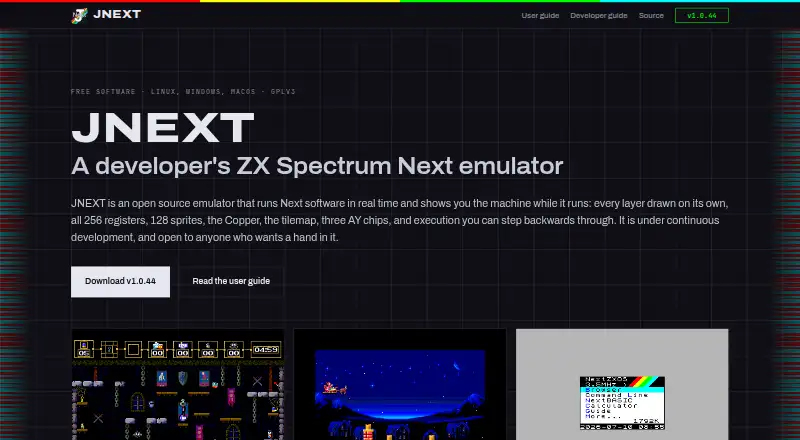
JNEXT is a free, open-source emulator for ZX Spectrum software, with developer-oriented debugging and automation tools. It emulates 48K, 128K, +2A/+3, and ZX Spectrum Next Issue 2 machines. The debugger offers hardware views, registers, breakpoints, and backward execution; headless mode and deterministic screenshots support CI testing. Supported files include NEX, SNA, SZX, Z80, TAP, TZX, WAV, and RZX. Emulated audio includes three AY chips, a DAC, and a beeper, and supported peripherals include DivMMC, DMA, USB gamepads, and an ESP-01 WiFi module; networking is off by default. On first run, JNEXT can download the official NextZXOS SD-card image if none is configured. The original and working images together use about 2 GB of disk space. Packages are offered for Linux, Windows, and macOS under GPLv3. The project remains under development, and extreme cycle-exactness is not a goal. The Windows executable is not code-signed, and the macOS app is not notarized, affecting their first-launch warnings or blocking behavior.
Who it is for
JNEXT suits ZX Spectrum users and developers who need an emulator with debugging and CI automation features. Its broad machine and file-format support may help with varied software, while platform security prompts require attention.
What is good
- Emulates 48K, 128K, +2A/+3, and Next Issue 2.
- Debugger includes breakpoints and backward execution.
- Headless mode and deterministic screenshots support CI.
- Supports Linux, Windows, and macOS.
- GPLv3 free software with no ads.
What to know first
- Project is still under development.
- Extreme cycle-exactness is not a goal.
- Windows executable is not code-signed.
- macOS app is not notarized.
Specifiction review
JNEXT: the full review
JNEXT pairs ZX Spectrum emulation with debugging and automation features across desktop platforms. Account for its development status and the stated Windows and macOS launch restrictions.
JNEXT is a ZX Spectrum emulator with a developer-oriented debugger and automation tools. It suits people building or testing Spectrum Next software who want to work across desktop operating systems. The main trade-off is a project still in development, with no goal of extreme cycle-exactness.
Overview
JNEXT is free software under GPLv3, created by Jorge Gonzalez (ZXjogv). It emulates Spectrum 48K, 128K, +2A/+3, and ZX Spectrum Next Issue 2 machines. Its combination of emulation, debugging, and CI-oriented automation makes it more compelling for development than for users seeking only a simple player.
The maker directs questions and bug reports to the GitHub issue tracker. The project says it has no ads or products for sale, and no trackers beyond a self-hosted page counter.
Key features
Emulation and peripherals
JNEXT models ULA and Timex video modes, Layer 2, 128 hardware sprites, tilemap, and Copper, alongside three AY-3-8910 chips, a DAC, and a beeper. Support for DivMMC and SD card, Multiface, DMA, UART, CTC, SPI/I²C, a real-time clock, USB gamepads, and Kempston mouse gives developers a broad set of machine components to work with.
It emulates the ESP-01 WiFi module so Next software can reach the real network, though networking is off by default. Next boots NextZXOS from an SD-card image; JNEXT can fetch the official distribution on first run when none is configured. The original and working images together use about 2 GB of disk space, a meaningful cost for a setup that relies on the default images.
Development, testing, and files
The debugger provides hardware views, registers, breakpoints, and backward execution. That is a substantial advantage for diagnosing software behavior compared with an emulator focused only on running programs. Headless operation and deterministic screenshots support CI testing without a graphical session.
JNEXT handles NEX, SNA, SZX, and Z80 snapshots, plus TAP, TZX, WAV, and RZX tape or session formats. RZX captures input alongside a machine snapshot and can be replayed in an emulator modeling the machine the same way. It can record video with audio to MP4 when ffmpeg is installed, and record audio to WAV without ffmpeg or a sound card.
Pricing
Free software — 0.00 USD per free. The plan is GPLv3, with no ads and nothing for sale. There is no paid tier or trial to weigh against the free option. That makes it a straightforward choice for developers who want open-source tooling without a purchase; the trade-off is that questions and bug reports go through the GitHub issue tracker.
Platforms
Packages are offered for Linux, Windows, and macOS; Linux packages include deb, rpm, and Flatpak. Windows users should expect a SmartScreen warning because the executable is not code-signed. On macOS, the app is ad-hoc signed but not notarized, so Gatekeeper blocks its first launch. These launch restrictions add friction before use, particularly for users who expect a conventional signed application.
Who it's for
JNEXT is best for developers working on ZX Spectrum Next programs who need inspectable machine state, reversible execution, and repeatable CI checks. Its broad peripheral and file-format support also suits people moving programs and recordings among Spectrum setups. It is a weaker fit when extreme cycle-exactness is essential, or when a project still under development and platform security prompts are unacceptable.
Pros and cons
- Pros: Built-in hardware views, registers, breakpoints, and backward execution make it useful for debugging rather than emulation alone.
- Pros: Headless mode and deterministic screenshots give CI workflows a direct way to exercise and capture programs.
- Pros: Support for Next hardware, peripherals, and common snapshot, tape, and session formats covers varied development workflows.
- Cons: Extreme cycle-exactness is not a project goal, ruling it out for work that depends on that level of timing fidelity.
- Cons: Windows SmartScreen warnings and macOS Gatekeeper's first-launch block make initial setup less seamless.
- Cons: The NextZXOS images take about 2 GB together, and the project remains under development.
Alternatives
For other ZX Spectrum emulators, browse ZX Spectrum Emulators. Unreal Speccy Portable is another free, open-source choice, with Android support in addition to Linux, macOS, and Windows. Klive IDE is a free, open-source option for Linux, macOS, and Windows, described as a not-for-profit passion project.
zx_go is a free, open-source emulator for Linux, macOS, and Windows; its licensed Spectrum Next ROMs are not bundled. CSpect is another free option, with no support or warranty and no guaranteed updates. GZX is free software for Linux and Windows, with ZX Spectrum ROM files excepted from its MIT-style license.
ZEsarUX is free software for Linux, macOS, Windows, and self-hosted use, with optional donations. Spectral is a free, open-source experimental emulator whose code is prone to change. RustZX is an open-source option for Linux and Windows.
Verdict
Choose JNEXT if you are developing ZX Spectrum Next software and want debugging and CI automation in a free, GPLv3 emulator. Look elsewhere if exact cycle timing is central to your work, or if you need a project beyond development status with uncomplicated first launch on Windows or macOS.
JNEXT plans and pricing
All plansCompared on ZX spectrum emulators
- Free plan
- Yesjnext.es
- Host platforms
- Linux, Windows, macOSjnext.es
- Tape formats
- TAP, TZX, WAVjnext.es
- Snapshot formats
- NEX, SNA, SZX, Z80jnext.es
- Built-in debugger
- Yesjnext.es
- Open source
- Yesjnext.es
- Peripheral support
- DivMMC, SD card, Multiface, DMA, UART, CTC, SPI, I²C, real-time clock, keyboard, USB gamepads, Kempston mouse, ESP-01 WiFi modulejnext.es
Facts
- Purpose
- JNEXT is an open-source ZX Spectrum Next emulator for developers.jnext.es · 29 Sept 2026
- License
- JNEXT is free software under the GPLv3 license.jnext.es · 29 Sept 2026
- Emulation
- It emulates 48K, 128K, +3, and ZX Spectrum Next Issue 2 machines.github.com · 29 Sept 2026
- Debugger
- Its debugger includes hardware views, registers, breakpoints, and backward execution.jnext.es · 29 Sept 2026
- Automation
- JNEXT supports headless mode and deterministic screenshots for testing programs in CI.github.com · 29 Sept 2026
- Audio and peripherals
- The emulator includes three AY chips, a DAC, a beeper, and support for peripherals including DivMMC, DMA, and USB gamepads.github.com · 29 Sept 2026
- File formats
- Supported formats include NEX, SNA, SZX, Z80, TAP, TZX, WAV, and RZX.github.com · 29 Sept 2026
- Downloads
- Packages are offered for Linux, Windows, and macOS, with Linux packages including deb, rpm, and Flatpak.jnext.es · 29 Sept 2026
- Support
- The maker directs bug reports and questions to the GitHub issue tracker.jnext.es · 29 Sept 2026
- Known limits
- The project says it is still under development, and extreme cycle-exactness is not a goal.github.com · 29 Sept 2026
- Windows signing
- The Windows executable is not code-signed, and the site says SmartScreen may warn that the publisher is unrecognized.github.com · 29 Sept 2026
- macOS notarization
- The macOS app is ad-hoc signed but not notarized, so Gatekeeper blocks its first launch.github.com · 29 Sept 2026
- Privacy
- The site says it has no ads and no trackers beyond a self-hosted page counter.jnext.es · 29 Sept 2026
- Product
- JNEXT is an open source emulator for running ZX Spectrum Next software in real time, with a developer focused view of the machine.jnext.es · 30 Sept 2026
- Emulated machines
- It emulates ZX Spectrum 48K, 128K, +2A/+3, and ZX Spectrum Next (Issue 2).jnext.es · 30 Sept 2026
- Video and audio
- Emulated hardware includes ULA and Timex modes, Layer 2, 128 hardware sprites, tilemap, Copper, three AY-3-8910 chips, DAC, and beeper.jnext.es · 30 Sept 2026
- Storage and peripherals
- The emulator lists DivMMC and SD card, Multiface, DMA, UART, CTC, SPI/I²C, and real-time clock support.jnext.es · 30 Sept 2026
- Networking
- JNEXT emulates the ESP-01 WiFi module so Next software can reach the real network; networking is off by default.jnext.es · 30 Sept 2026
- Operating system image
- The Next boots NextZXOS from an SD-card image, and JNEXT can download the official distribution image on first run if none is configured.jnext.es · 30 Sept 2026
- Image storage limit
- The downloaded original and working SD-card image together take about 2 GB of disk space.jnext.es · 30 Sept 2026
- Recording
- JNEXT can record video with audio to MP4 when ffmpeg is installed and can record audio to WAV without ffmpeg or a sound card.jnext.es · 30 Sept 2026
- Session playback
- RZX files record user input alongside a machine snapshot and can be replayed in an emulator that models the machine the same way.jnext.es · 30 Sept 2026
- Audience
- The user guide covers ordinary program use and also developer tools, debugging, and automation in CI.jnext.es · 30 Sept 2026
- Privacy and funding
- The site says JNEXT has no ads, nothing for sale, and no trackers beyond a self-hosted page counter.jnext.es · 30 Sept 2026
- License and maker
- JNEXT is free software under GPLv3 by Jorge Gonzalez (ZXjogv), and the site says it is not affiliated with SpecNext Ltd.jnext.es · 30 Sept 2026
Best JNEXT alternatives
See all 20
Where it ranks on Specifiction
Is JNEXT yours?
Claim it for free: prove the domain, then correct facts, plans and screenshots. An editor reviews every change.
Sources
- jnext.es· checked 29 Sept 2026
- github.com/jorgegv/jnext· checked 29 Sept 2026
- jnext.es/user-guide/· checked 29 Sept 2026
- jnext.es/user-guide/01-introduction/01-what-it-e· checked 30 Sept 2026
- jnext.es/user-guide/03-first-run/02-letting-jnex· checked 30 Sept 2026
- jnext.es/user-guide/05-running-programs/05-recor· checked 30 Sept 2026