Tech riderRev. 20 Sept 2026
KubeSolo
- 1Runs onLinux, Mac, self-hosted, Windows
- 2CostsNot stated by the maker
- 3Supported operating systemsLinux distributions including Ubuntu, Debian, Alpine, CentOS, and Raspbian; macOS and Windows via container mode with WSL2
- 4Multi-node clustersNo
- 5Container runtime optionscontainerd and crun
4 lines stated Written from the maker's own pages: kubesolo.io
Overview
KubeSolo is ranked #14 of 23 in local Kubernetes tools on Specifiction. It runs on Linux, macOS, Self-hosted, Windows.
Compared on local Kubernetes tools
- Free plan
- Yeskubesolo.io
- Supported operating systems
- Linux distributions including Ubuntu, Debian, Alpine, CentOS, and Raspbian; macOS and Windows via container mode with WSL2kubesolo.io
- Multi-node clusters
- Nokubesolo.io
- Container runtime options
- containerd and crunkubesolo.io
Facts
- Product
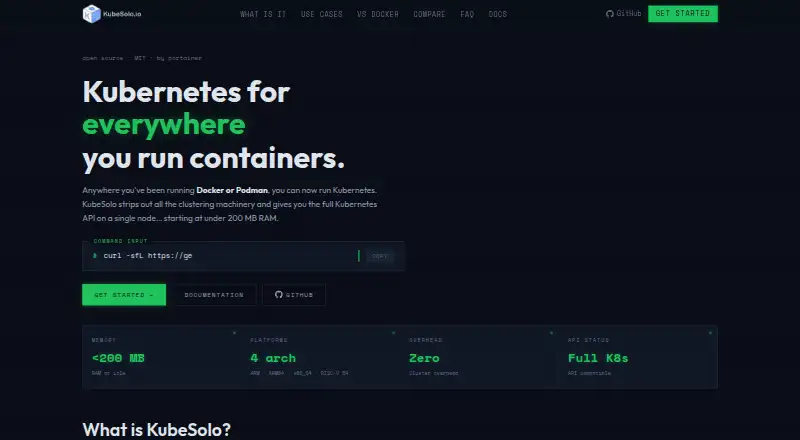
- KubeSolo is a single-node Kubernetes distribution that removes clustering machinery while exposing the full Kubernetes API.kubesolo.io · 5 Oct 2026
- License
- KubeSolo is open source under the MIT license.kubesolo.io · 5 Oct 2026
- Memory
- The site describes KubeSolo as using under 200 MB RAM at idle.kubesolo.io · 5 Oct 2026
- Architecture support
- Supported architectures are ARM, ARM64, x86_64, and RISC-V 64.kubesolo.io · 5 Oct 2026
- Features
- The site lists support for standard Kubernetes manifests, Helm, CRDs, RBAC, ServiceAccounts, namespace isolation, health probes, restart policies, and resource limits.kubesolo.io · 5 Oct 2026
- Integrations
- KubeSolo supports Portainer Edge Agent for centralized fleet management, GitOps deployments, cross-node RBAC, and remote lifecycle management.kubesolo.io · 5 Oct 2026
- Networking
- KubeSolo includes an integrated CNI, CoreDNS, and native ClusterIP, NodePort, and LoadBalancer service types.kubesolo.io · 5 Oct 2026
- Storage
- KubeSolo includes Rancher's local-path-provisioner by default and supports CSI drivers.kubesolo.io · 5 Oct 2026
- Offline use
- The site says KubeSolo can run fully offline without cloud connectivity or external registries.kubesolo.io · 5 Oct 2026
- Intended users
- The site describes use cases including edge devices, factory and OT infrastructure, IoT hardware, developer workstations, remote sites, and kiosks.kubesolo.io · 5 Oct 2026
- Single-node scope
- KubeSolo is single-node by design; managing multiple instances centrally requires a multi-cluster management solution such as Portainer.kubesolo.io · 5 Oct 2026
- Certification
- The FAQ says KubeSolo is not currently CNCF-certified.kubesolo.io · 5 Oct 2026
- Requirements
- Installation requires a modern Linux distribution, sudo access, curl, iptables, and libsqlite3-dev; the guide also says no container engine should be installed or active on the target system.kubesolo.io · 5 Oct 2026
- Compatibility limit
- The documentation says some operators, add-ons, and CSI drivers that assume /var/lib/kubelet may need configuration for KubeSolo's custom kubelet directory.kubesolo.io · 5 Oct 2026
- What it is
- KubeSolo is an open source, MIT-licensed single-node Kubernetes distribution maintained by Portainer.kubesolo.io · 7 Oct 2026
- Purpose
- It provides the full Kubernetes API on a single node, removing clustering machinery such as etcd quorum logic and multi-node networking overlays.kubesolo.io · 7 Oct 2026
- Resource use
- The homepage states that KubeSolo uses under 200 MB of RAM at idle.kubesolo.io · 7 Oct 2026
- Docker compatibility
- The d2k component exposes a Docker-compatible API over mTLS so Docker CLI commands, scripts, and CI jobs can target a KubeSolo node.kubesolo.io · 7 Oct 2026
- Observability
- The product includes a Prometheus metrics endpoint for component health, certificate expiry, and database size, with ready-made Grafana dashboards.kubesolo.io · 7 Oct 2026
- Networking and storage
- It includes an integrated CNI plugin, CoreDNS, built-in LoadBalancer behavior, and local-path-provisioner for persistent volumes.kubesolo.io · 7 Oct 2026
- Security
- Its Docker-compatible d2k API uses mTLS, and the product supports Kubernetes RBAC and namespace isolation.kubesolo.io · 7 Oct 2026
- Supported environments
- Linux installation supports ARM, ARM64, x86_64, and RISC-V 64; kubesoloctl can run KubeSolo in a Docker container on macOS and Windows WSL2.kubesolo.io · 7 Oct 2026
- Notable limitation
- KubeSolo is single-node by design and the FAQ says it is not currently CNCF-certified.kubesolo.io · 7 Oct 2026
- Hardware guidance
- The FAQ describes KubeSolo as designed for resource-constrained devices, including systems with less than 1 GB RAM, and says standard lightweight distributions are generally a better fit at 1 GB or more.kubesolo.io · 7 Oct 2026
Best KubeSolo alternatives
See all 20 All accessCh 01 Kunobi Free planFree trialLinux from $912/mo7.7 All accessCh 02 vCluster Platform Free planFree trialAPI Free to start7.7 All accessCh 03 Kubeterm Free planAndroidiOS Free to start7.4 All accessCh 04 Seabird Free trialLinuxMac 7.4 All accessCh 05 srelens Free planAPILinux Free to start7.4 All accessCh 06 Rancher Desktop Free planAPILinux Free to start7.3



Where it ranks on Specifiction
- Best Local Kubernetes Tools in 2026#14 of 23
Is KubeSolo yours?
Claim it for free: prove the domain, then correct facts, plans and screenshots. An editor reviews every change.
Sources
- kubesolo.io· checked 5 Oct 2026
- kubesolo.io/about· checked 5 Oct 2026
- kubesolo.io/documentation· checked 5 Oct 2026
- kubesolo.io/get-started· checked 5 Oct 2026