
Oracle Autonomous AI Lakehouse
- 1Runs onAPI, Linux, self-hosted, Web
- 2CostsFree plan · free trial
- 3Storage modelboth
- 4SQL analyticsYes
- 5Table format supportboth
- 6Streaming ingestionYes
- 7Governance catalogYes
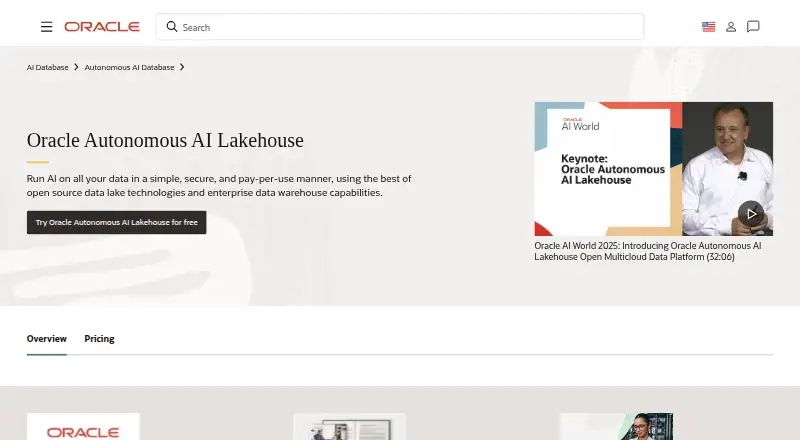
Overview
Oracle Autonomous AI Lakehouse is a pay-per-use platform for working with data through open lake technologies and enterprise data warehouse capabilities. It can query Apache Iceberg tables across clouds without moving the data, and is available on OCI, AWS, Azure, Google Cloud, and Exadata Cloud@Customer. It supports structured, semi-structured, and unstructured data, with catalog integrations including OCI Data Catalog, AWS Glue, and Apache Iceberg catalogs in Databricks and Snowflake. Data Studio provides drag-and-drop workflows for integrating data from more than 100 application, cloud service, and database sources, and enables bidirectional sharing with Power BI and Tableau through Delta Sharing. Its AI and analytics tools include machine learning, graph and spatial analytics, and AI Vector Search for semantic search and retrieval-augmented generation. Select AI can use models from providers including Cohere, OpenAI, Google, Anthropic, and AWS. Oracle says automated management covers provisioning, security, tuning, and scaling. The Always Free offer includes two database instances, subject to capacity limits; a separate trial provides US$300 in cloud credits for up to 30 days.
Who it is for
It suits teams combining cloud-based lake data with warehouse, analytics, and AI workflows. Its listed integrations and multiple deployment options may also fit organizations working across cloud services and data catalogs.
What is good
- Queries Iceberg tables in place across clouds
- Supports three data types
- Integrates with more than 100 data sources
- Offers machine learning and AI Vector Search
- Includes two Always Free database instances
What to know first
- Free use is subject to capacity limits
- Trial credits expire after spending or 30 days
- Several plans have no listed price
- Dedicated infrastructure has a 48-hour minimum subscription term
Specifiction review
Oracle Autonomous AI Lakehouse: the full review
Oracle combines lakehouse querying, data integration, analytics, and AI features in one platform. Free use and trial credits are specified, while most paid plan prices are not.
Oracle Autonomous AI Lakehouse is a managed platform for querying open lake data and building database, analytics, and AI workloads. It is best suited to organizations that want Oracle capabilities across multiple clouds and customer infrastructure. Its broad toolset is a strong fit for those teams, but usage-based billing makes workload costs central to the choice.
Overview
The service queries Apache Iceberg tables in place, so teams can work with lake data without moving it. It combines that access with SQL analytics, transactions, streaming ingestion, and support for structured, semi-structured, and unstructured data. Storage and compute can be separated, and hybrid deployment gives organizations a choice of managed cloud or customer infrastructure.
Oracle offers the service on OCI, AWS, Azure, Google Cloud, and Exadata Cloud@Customer. This breadth helps organizations working across cloud providers; the Oracle database foundation makes it a more natural choice for teams already invested in Oracle than for those seeking only a focused lake query layer.
Key features
Lake access and integration
Catalog integrations include OCI Data Catalog, AWS Glue, and Apache Iceberg catalogs in Databricks and Snowflake. Data Studio provides drag-and-drop workflows to integrate data from more than 100 application, cloud service, and database sources. That combination can reduce the friction of bringing varied data into workflows, though the platform’s scope may be more than a team needs for simple lake querying.
Data Studio also supports bidirectional sharing with services including Power BI and Tableau through Delta Sharing. That makes it relevant to teams that need to exchange data with those analytics tools, rather than confining sharing to Oracle products.
AI, analytics, and operations
Select AI can use models from Cohere, Azure OpenAI, OpenAI, OCI Generative AI, Google, Anthropic, Hugging Face, and AWS, among others. Machine learning, graph analytics, spatial features, and AI Vector Search extend the platform to semantic search and retrieval-augmented generation. This is a broad set of capabilities for organizations building analytical and AI workloads around their data, but buyers should choose it for those combined needs rather than assuming they need every component.
Oracle says autonomous management handles provisioning, configuration, security, tuning, and scaling. Data is encrypted at rest and in transit by default, with security patches and updates applied automatically; Oracle also states the database meets a broad set of international and industry-specific compliance standards. These managed controls suit teams seeking an operated database service, though no specific compliance standards are named here.
For local development, Oracle offers an unlimited-time container image for offline use, with Database Actions, ORDS, APEX, and the Database API for MongoDB. Document support includes JSON and OSON, with a maximum document size of 32 MB.
Pricing
The Always Free Autonomous AI Lakehouse plan is free. It provides two Autonomous AI Database instances through Oracle Cloud Free Tier, with free use for an unlimited time subject to capacity limits. It is a useful way to explore the service or support modest workloads, but capacity limits constrain how much sustained work it can carry.
The trial provides US$300 in cloud credits for up to 30 days. Credits expire when spent or when 30 days elapse, whichever comes first, so it is a short evaluation window rather than a continuing allowance.
Oracle Autonomous AI Lakehouse Serverless has custom pricing, billed per ECPU per hour, with storage and backup storage billed per gigabyte per month. Its usage-based structure can suit variable workloads, but the ECPU and storage charges make consumption an important cost factor. Exadata Cloud@Customer and Dedicated Infrastructure also have custom pricing, billed per ECPU per hour; each lists developer-instance usage billed per hour. Dedicated Infrastructure has a 48-hour minimum term for the Database Exadata Infrastructure subscription, a commitment that matters for shorter deployments.
Bring Your Own License has custom pricing and is billed per ECPU per hour. It applies to Serverless, Dedicated, and Exadata Cloud@Customer, making it an option for Oracle license holders, though it does not remove the usage-based ECPU charge.
Platforms
Platforms include API, Linux, self-hosted, and web. Cloud availability spans OCI, AWS, Azure, and Google Cloud, with Exadata Cloud@Customer for customer infrastructure. The service supports hybrid deployment, and the offline container provides a local development path.
Who it's for
Choose Oracle Autonomous AI Lakehouse if your organization needs Iceberg access alongside Oracle database services, cross-cloud availability, data integration and sharing, and built-in analytics or AI capabilities. It is especially relevant to teams already using Oracle or operating across the listed cloud environments. It is a weaker fit for buyers who want only a narrow lake query service or who need predictable prices before estimating their usage.
Pros and cons
- Broad cloud reach: Availability across OCI, AWS, Azure, Google Cloud, and Exadata Cloud@Customer supports varied infrastructure arrangements.
- Open lake access: Querying Iceberg tables in place avoids moving that data into the service.
- Integrated data and AI tooling: More than 100 integration sources, bidirectional Delta Sharing, and multiple model providers cover varied workflows in one platform.
- Capacity-limited free plan: Two instances and unlimited-time use help with evaluation, but capacity limits restrict the free tier’s usefulness for larger workloads.
- Usage-based paid plans: ECPU, storage, backup, and developer-instance charges can align costs with consumption, but make budgets harder to pin down without workload estimates.
Alternatives
For other options, browse Data Lakehouse Platforms, Document Databases, Data Warehouse Software, OLAP Databases, and OLAP Software.
Starburst Galaxy is worth considering if a free plan with up to three clusters for ad hoc queries is a closer fit. Starburst Data Platform also offers a free plan with up to three clusters for ad hoc queries, alongside API, Linux, self-hosted, and web platforms.
Amazon SageMaker Autopilot is a pay-as-you-go alternative with no minimum fees or upfront commitments, for readers who want that billing model. Bauplan offers a free Sandbox with public datasets or user uploads, a full CLI, SDK, and API, and community Slack support; pick it if that sandbox model suits your work.
Databricks Notebooks offers a free edition with one serverless workspace and limited compute size and usage. IOMETE has a free self-hosted, on-premises plan capped at 100 vCPUs, which may suit readers prioritizing that deployment option. Apache Hudi is a free open-source lakehouse platform for readers who prefer source releases and Maven artifacts. Cloudera Data Lake Service is another option for readers comparing data lake services.
Verdict
Oracle Autonomous AI Lakehouse is a strong choice for organizations that want Iceberg querying, integration, analytics, and AI on an Oracle database foundation across cloud and customer infrastructure. Its breadth and free access make it worth considering, but teams should look elsewhere if they need clear paid-plan costs upfront or only a focused lake query tool.
Oracle Autonomous AI Lakehouse plans and pricing
All plansCompared on OLAP software
- Storage model
- bothoracle.com
- SQL analytics
- Yesoracle.com
- Table format support
- bothoracle.com
- Streaming ingestion
- Yesoracle.com
- Governance catalog
- Yesoracle.com
Facts
- Purpose
- Oracle describes Autonomous AI Lakehouse as a pay-per-use platform for running AI on data with open-source lake technologies and enterprise data warehouse capabilities.oracle.com · 3 Oct 2026
- Open lakehouse access
- It queries Apache Iceberg tables in place across clouds using Oracle AI Database 26ai features without moving the data.oracle.com · 3 Oct 2026
- Cloud availability
- Oracle says the service is available on OCI, AWS, Azure, Google Cloud, and Exadata Cloud@Customer.oracle.com · 3 Oct 2026
- Data formats
- The platform supports structured, semi-structured, and unstructured data types.oracle.com · 3 Oct 2026
- Catalog integrations
- Its catalog can work with OCI Data Catalog, AWS Glue, and Apache Iceberg catalogs in Databricks and Snowflake.oracle.com · 3 Oct 2026
- Data sharing
- Data Studio supports bidirectional data sharing with services including Power BI and Tableau using the Delta Sharing protocol.oracle.com · 3 Oct 2026
- Data engineering
- Data Studio provides drag-and-drop workflows to integrate data from more than 100 application, cloud service, and database sources.oracle.com · 3 Oct 2026
- AI models
- Select AI can use models from Cohere, Azure OpenAI, OpenAI, OCI Generative AI, Google, Anthropic, Hugging Face, and AWS, among others.oracle.com · 3 Oct 2026
- AI and analytics
- The service includes machine learning, graph analytics, spatial features, and AI Vector Search for semantic search and retrieval-augmented generation.oracle.com · 3 Oct 2026
- Automation
- Oracle says autonomous management handles provisioning, configuration, security, tuning, and scaling.oracle.com · 3 Oct 2026
- Security
- Oracle says Autonomous AI Database encrypts data at rest and in transit by default and automatically applies security patches and updates.docs.oracle.com · 3 Oct 2026
- Compliance
- Oracle states that Autonomous AI Database meets a broad set of international and industry-specific compliance standards.docs.oracle.com · 3 Oct 2026
- Free usage limits
- The Always Free offer includes two Autonomous AI Database instances; Oracle says free usage is unlimited in time but subject to capacity limits.oracle.com · 3 Oct 2026
- Trial terms
- Oracle offers US$300 in cloud credits for up to 30 days, and says the credit expires when spent or when 30 days elapse, whichever comes first.oracle.com · 3 Oct 2026
- Local development
- Oracle offers an unlimited-time container image for offline development in a local environment, with tools including Database Actions, ORDS, APEX, and the Database API for MongoDB.oracle.com · 3 Oct 2026
Company
- Founded
- 1977oracle.com · 28 Sept 2026
- Headquarters
- Austin, Texas, USAoracle.com · 28 Sept 2026
Best Oracle Autonomous AI Lakehouse alternatives
See all 20



Where it ranks on Specifiction
- Best OLAP Software in 2026#6 of 34
- Best OLAP Databases in 2026#5 of 31
- Best Document Databases in 2026#7 of 26
- Best Data Warehouse Software in 2026#4 of 25
- Best Data Lakehouse Platforms in 2026#1 of 24
Is Oracle Autonomous AI Lakehouse yours?
Claim it for free: prove the domain, then correct facts, plans and screenshots. An editor reviews every change.
Sources
- oracle.com/autonomous-database/autonomous-ai-lakeh· checked 3 Oct 2026
- docs.oracle.com/en-us/iaas/autonomous-database-serverle· checked 3 Oct 2026
- oracle.com/autonomous-database/free-trial/· checked 3 Oct 2026
- oracle.com/autonomous-database/autonomous-ai-lakeh· checked 3 Oct 2026