Recognition Technologies Speaker Recognition
- 1Runs onAndroid, API, iOS, Linux, Mac, self-hosted, Web, Windows
- 2Costsfree trial
- 3Speaker identificationYes
- 4Voice authenticationYes
- 5Deploymenthybrid
- 6SDK platformsLinux, Windows, macOS, Android, iOS, Web, C++
- 7API accessYes
Overview
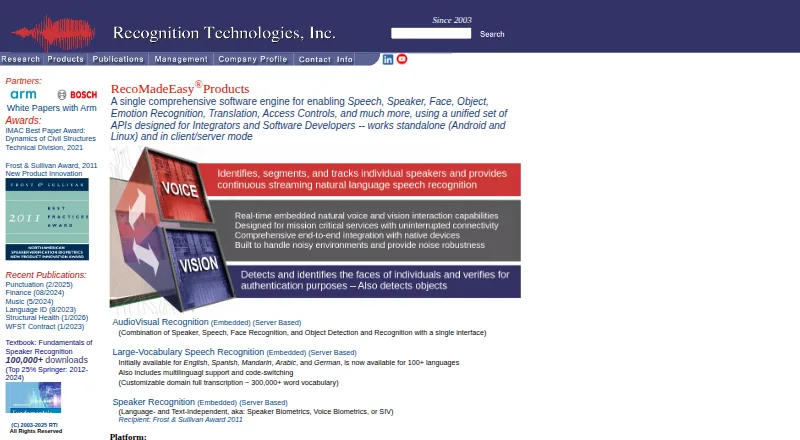
Recognition Technologies Speaker Recognition is a language- and text-independent voice biometrics system for identifying and verifying speakers. A person may enroll in one language and be identified or verified in another. The engine also supports classification, detection, tracking and segmentation. Identification can use open-set or closed-set approaches; closed-set identification can return the nearest enrolled voice even if the speaker is not in the database. The maker describes verification enrollment as about 30 seconds of speech, followed by a few seconds when the speaker returns. Interfaces include a C++ SDK/API, command line, web service, Android and iOS; the engine can also be used as a module of the maker’s IVR system. Deployment options include embedded, server-based, standalone, hosting at Recognition Technologies or hosting at the customer’s facilities. The product page lists Linux, Apple Macintosh OS X and Windows support. Its telephony version supports speaker verification and identification for telephone authentication and access-level control. Pricing is on request, and an evaluation account for the hosted version may be available to interested organizations.
Who it is for
It suits organizations considering voice-based speaker identification or verification, including telephone authentication and access-level control. The hosted version may be evaluated by interested organizations, subject to availability.
What is good
- Supports identification, verification, classification and tracking
- Enrollment and recognition can use different languages
- Offers embedded, server-based and hosted deployments
- Lists C++, web, Android and iOS interfaces
What to know first
- Pricing is on request
- Reducing false acceptance can increase false rejections
Specifiction review
Recognition Technologies Speaker Recognition: the full review
Recognition Technologies Speaker Recognition offers multiple recognition modes and deployment choices, including telephony use. Pricing requires an inquiry, and verification involves a trade-off between false acceptance and false rejection.
Recognition Technologies Speaker Recognition is a language- and text-independent voice biometrics engine for identity checks and speaker analysis. It is best suited to organizations building multilingual or telephone-authentication workflows that need deployment flexibility. Its broad set of recognition modes is a strength; custom pricing and a consequential verification trade-off make evaluation important.
Overview
Also called RecoMadeEasy Speaker Recognition, the engine supports identification, verification, classification, detection, tracking, and segmentation. Language independence lets a person enroll in one language and be identified or verified in another, useful where a service cannot assume that every speaker will use the same language.
Identification offers both open-set and closed-set approaches. In closed-set use, the engine can return the closest enrolled voice even when the speaker is not in the database. That behavior may be useful when a workflow needs a nearest candidate, but it is a poor fit unless the surrounding process can handle a result that is not a confirmed match.
Key features
Verification and telephony
For verification, enrollment uses about 30 seconds of speech; a returning speaker supplies a few seconds. The telephony version supports speaker verification and identification for telephone authentication and access-level control, and can complement the maker’s IVR product. That combination makes it relevant to organizations looking to add voice-based checks to telephone workflows.
There is an important operational trade-off: reducing false acceptance can increase false rejection. Teams need to decide which error is more costly in their setting and evaluate the hosted version before relying on it for access decisions. An evaluation account may be made available to interested organizations.
Integration and audio
Interfaces include a C++ SDK/API, command line, web service, Android and iOS interfaces, and use as a module in the maker’s IVR system. The server-based engine is compatible with microphone devices and most audio file formats; Dialogic JCT T1 and analog telephony cards are named as natively supported. This mix gives implementers several integration routes, though the fit depends on their environment and chosen deployment.
Pricing
The product is paid, with custom pricing. A hosted-version evaluation account may be made available to interested organizations, but no trial length or plan terms are established. The maker says the engine can be customized for specific needs and operating environments, so organizations should discuss deployment and requirements directly with Recognition Technologies.
Platforms
Deployment choices include embedded, server-based, standalone, hosted by Recognition Technologies, and hosted at the customer’s facilities. The engine runs on most Linux distributions, Apple Macintosh OS X, and Microsoft Windows; interfaces also include Android and iOS, as well as web, command-line, and C++ API access. This is a substantial range for organizations choosing between hosted access and their own facilities, but platform breadth alone does not establish compatibility with a particular system.
Who it's for
This is a candidate for organizations that need voice identification or verification across languages, telephone authentication, or broader speaker analysis, and that can assess error trade-offs and deployment fit before adoption. Its multiple hosting and interface options suit teams with varied operating environments. It is less appropriate for buyers who need predictable published pricing or cannot tolerate the possibility that tightening false acceptance will raise false rejections.
Pros and cons
- Pros: Language-independent enrollment and recognition can support multilingual identity workflows.
- Pros: Identification, verification, classification, detection, tracking, and segmentation cover more than authentication alone.
- Pros: Embedded, standalone, server, and hosted deployment choices provide flexibility over where the engine runs.
- Cons: Custom pricing means buyers must contact the maker to establish cost.
- Cons: The verification trade-off between false acceptance and false rejection requires careful policy and evaluation.
- Cons: Closed-set identification may return the nearest enrolled voice even for an unregistered speaker, requiring a workflow that treats that result cautiously.
Alternatives
AI Voice Biometrics Software is a broader category to explore when comparing products. Consider Voiceme VoiceKey if its Android, API, extension, iOS, Linux, macOS, self-hosted, web, and Windows platform coverage fits; pricing requires a demo request. VoiceVantage VoiceCheck offers SDK and SaaS SDK options, with licensing details requiring contact for the SDK and per-license billing for the SaaS SDK.
armour365 Voice Biometrics is worth considering for a freemium route: its Developers plan is 0.00 USD per free, while its small-business plan gives the first 10K transactions free and charges $2.99/1K trans for 10K–100K. Spiron Voice Biometrics API is another paid API option with a free trial and Linux and self-hosted platform support.
Resemble Detect may suit teams seeking audio, image, and video detection: its free Flex plan includes one team seat, pay-as-you-go credits, and platform and API access; its Team plan is 280.00 USD per ye. LumenVox Active Voice Biometrics offers a Capacity Private Cloud Active Voice Biometrics plan with custom pricing. AwareSDK Voice is an Android and iOS option with pricing available by demo or contact. GoVivace Speaker Verification API is another paid API and self-hosted option.
Verdict
Choose Recognition Technologies Speaker Recognition if you need language-independent voice identity or telephone authentication and value a choice of deployment models and analysis modes. Its main advantage is that breadth; its main reason to look elsewhere is the need to negotiate pricing and validate how false acceptance and false rejection affect your workflow.
Compared on AI voice biometrics software
- Speaker identification
- Yesrecotechnologies.com
- Voice authentication
- Yesrecotechnologies.com
- Deployment
- hybridrecotechnologies.com
- SDK platforms
- Linux, Windows, macOS, Android, iOS, Web, C++recotechnologies.com
- API access
- Yesrecotechnologies.com
Facts
- What it does
- The product provides language- and text-independent speaker recognition, also described as voice biometrics or SIV.recotechnologies.com · 29 Sept 2026
- Recognition modes
- It supports speaker identification, verification, classification, detection, tracking, and segmentation.recotechnologies.com · 29 Sept 2026
- Language independence
- A person may enroll in one language and be identified or verified in another.recotechnologies.com · 29 Sept 2026
- Operating systems
- The product page says the engine runs on most Linux distributions, Apple Macintosh OS X, and Microsoft Windows.recotechnologies.com · 29 Sept 2026
- Interfaces
- The engine provides a C++ API, web, Android, iOS, and command-line interfaces.recotechnologies.com · 29 Sept 2026
- Audio compatibility
- The server-based page says the engine is compatible with all microphone devices and most audio file formats, and lists Dialogic JCT T1 and analog telephony cards as natively supported.recotechnologies.com · 29 Sept 2026
- Telephony use
- The telephony version supports speaker verification and identification for telephone authentication and access-level control, and complements the company’s IVR product.recotechnologies.com · 29 Sept 2026
- Customization
- The maker says the engine may be customized for specific needs and operating environments.recotechnologies.com · 29 Sept 2026
- Evaluation
- An evaluation account for the hosted version may be made available to interested organizations.recotechnologies.com · 29 Sept 2026
- Support contact
- The maker lists U.S. and international telephone numbers and [email protected] for further information.recotechnologies.com · 29 Sept 2026
- Standards work
- The maker says its staff consulted with VoiceXML, M1, and ISO committees on speaker verification and identification standards.recotechnologies.com · 29 Sept 2026
- Maker background
- The company profile describes Recognition Technologies as a research and development organization whose RecoMadeEasy speaker recognition engine has been in use by clients since 2007.recotechnologies.com · 29 Sept 2026
- Purpose
- RecoMadeEasy Speaker Recognition is a language- and text-independent speaker biometrics system for speaker identification and verification.recotechnologies.com · 30 Sept 2026
- Open and closed set
- Identification supports open-set and closed-set approaches; the page says closed-set identification can return the closest enrolled voice even when the speaker is not in the database.recotechnologies.com · 30 Sept 2026
- Enrollment
- For speaker verification, the page describes enrollment using about 30 seconds of speech, followed by a few seconds of speech when the speaker returns.recotechnologies.com · 30 Sept 2026
- Interfaces and API
- The engine can be used through a C++ SDK/API, command line, web service, or as a module of the maker’s IVR system; the main product page also lists web, Android and iOS interfaces.recotechnologies.com · 30 Sept 2026
- Audio and telephony
- The page lists microphone devices, major audio file formats, and Dialogic JCT T1 and analog telephony cards as supported audio interfaces.recotechnologies.com · 30 Sept 2026
- Evaluation access
- An evaluation account for the hosted software may be made available to interested organizations.recotechnologies.com · 30 Sept 2026
- Verification trade-off
- The maker describes a trade-off in which reducing false acceptance can increase false rejections.recotechnologies.com · 30 Sept 2026
- Security use
- The telephony version is described as supporting speaker verification and identification for telephone authentication and access-level control.recotechnologies.com · 30 Sept 2026
Company
- Founded
- 2003recotechnologies.com · 28 Sept 2026
- Headquarters
- Westchester County, New York, United Statesrecotechnologies.com · 28 Sept 2026
Best Recognition Technologies Speaker Recognition alternatives
See all 20


Where it ranks on Specifiction
Is Recognition Technologies Speaker Recognition yours?
Claim it for free: prove the domain, then correct facts, plans and screenshots. An editor reviews every change.
Sources
- recotechnologies.com/products/spkr/· checked 29 Sept 2026
- recotechnologies.com/products/index.php· checked 29 Sept 2026
- recotechnologies.com/home/profile.html· checked 29 Sept 2026
- recotechnologies.com/products/index.php· checked 30 Sept 2026