Solink Drive-Thru AI
- 1Runs onAndroid, iOS, Web
- 2CostsNot stated by the maker
- 3Lane managementYes
- 4Kitchen coordinationYes
- 5Throughput analyticsYes
- 6Arrival detectionYes
- 7Deploymenthybrid
Overview
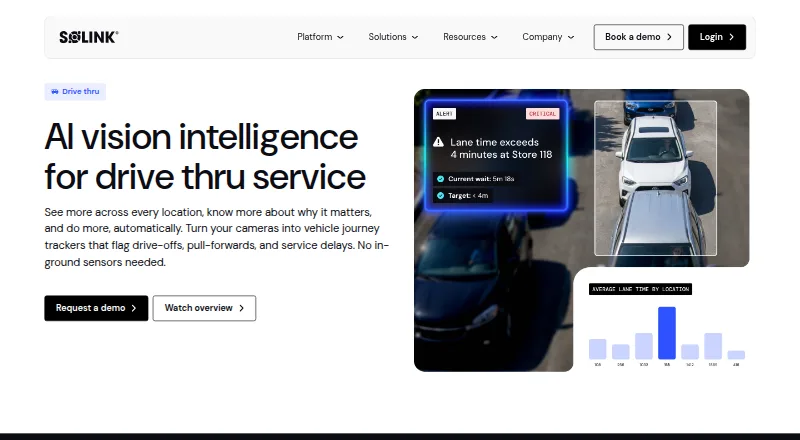
Solink Drive-Thru AI gives quick-service restaurants real-time monitoring across the drive-thru using existing cameras. Configurable detection zones can follow vehicles from lane entry and queueing through the menu board, service windows, and pull-forward. It measures time from order to handoff, flags drive-offs and pull-forwards, and can help identify a station or employee slowing service. Queue depth and arrival patterns by daypart can inform staffing, while video can help teams review greetings, employee placement, and distracted staff. Solink says the system works with single-lane and merge-lane layouts without structural changes or in-ground sensors. Its web-based Service Display Monitor pairs live lane video with real-time data. Solink lists more than 375 integrations, including POS, drive-thru timers, and labour data, and offers a simplified mobile version for iOS and Android. Its AI agents can correlate video with business data and flag events for human oversight or act autonomously. Pricing is available on request.
Who it is for
It is aimed at quick-service restaurant operators, including multi-site operations, that want to monitor drive-thru service, staffing, and guest interactions. Its lane tracking and integrations may suit teams with existing cameras and business data systems.
What is good
- Uses existing cameras without in-ground sensors.
- Tracks order-to-handoff lane times and drive-offs.
- Supports single-lane and merge-lane configurations.
- Lists more than 375 integrations.
- Offers onboarding and ongoing support at every site.
What to know first
- Pricing is available on request.
- Mobile users get a simplified version of the platform.
- Autonomous AI actions may not suit teams requiring human review.
Specifiction review
Solink Drive-Thru AI: the full review
Solink Drive-Thru AI focuses on lane performance, staffing patterns, and guest interactions without requiring in-ground sensors. Ask about pricing and deployment details to assess fit for a particular restaurant operation.
Solink Drive-Thru AI is a camera-based performance platform for quick-service restaurant drive-thrus, particularly suited to operators managing multiple sites. Its strongest case is connecting lane activity with service, staffing, and guest-interaction signals; the buying trade-off is a demo-led process with custom pricing.
Overview
The platform tracks vehicles across configurable camera zones, from lane entry and queue through the menu board, service windows, and pull-forward. That broad view helps managers investigate where service slows or demand builds, rather than relying on a single lane-time measure. Single-lane and merge-lane configurations are supported without structural changes, giving operators flexibility across different site layouts.
Solink says its AI agents can correlate video with business data and flag or act on events, either with human oversight or autonomously. That can support faster responses to operational issues, but operators should decide what level of automation and oversight suits their workflows. The platform runs on existing cameras without in-ground sensors or a hardware overhaul; camera coverage still needs to suit the lane layout. A web-based Service Display Monitor pairs live lane video with real-time data for kitchen coordination.
Key features
Lane flow and service timing
Solink measures time from order to handoff, detects pull-forwards before an order is complete, and helps identify the station or employee slowing service. Managers can use those signals to focus a process review or coaching on a likely bottleneck. The platform also flags vehicles leaving the queue and can compare lost vehicles with average ticket value, helping operators consider potential revenue impact alongside lane performance.
Staffing and guest experience
Queue depth and arrival patterns by daypart help managers match staffing to demand. Teams can review shift productivity, check employee placement and greetings, and identify distracted employees for coaching. These capabilities are most useful to operators who want to address both throughput and service consistency, though they require managers to turn observations into appropriate action.
Integrations, security, and support
Solink lists more than 375 integrations, including POS, drive-thru timers, and labour data, broadening the operational context available for analysis. It says every site receives onboarding and ongoing support. The company states that the platform is SOC 2 Type 2 and GDPR compliant, is NDAA-compliant, and does not use personally identifiable information of employees or patrons to train its models.
Pricing
Solink Drive-Thru AI is paid software with custom pricing. The product page invites prospective customers to request a demo rather than publishing a price, so it is a better fit for operators prepared to discuss deployment directly than for buyers comparing fixed, self-serve plans. No public seat limits, quotas, trial terms, or renewal terms are stated.
Platforms
The listed platforms are Android, iOS, and web. Solink’s mobile app provides a simplified version of the platform on iOS and Android, while the Service Display Monitor is web-based. Deployment is hybrid.
Who it's for
Drive-thru operators, especially multi-site quick-service restaurant teams, should consider Solink when they need to connect lane performance with staffing and guest interactions using existing cameras. It is less suited to buyers who need a publicly priced product or want to evaluate a fixed plan without a demo-led sales conversation.
Pros and cons
- Pros: Existing-camera operation avoids in-ground sensors and a hardware overhaul, and supports single-lane and merge-lane setups without structural changes.
- Pros: Lane timing, drive-off monitoring, staffing patterns, and guest-interaction signals bring several operational questions into one platform.
- Pros: More than 375 listed integrations and onboarding with ongoing support may help teams connect deployment to existing operations.
- Cons: Custom pricing and a request-a-demo buying path make quick budget comparisons harder.
- Cons: Mobile access is a simplified version, so teams needing the full platform on a phone should account for that distinction.
Alternatives
Restaurant Drive-Thru Software is a broader place to compare options. Consider SoundHound instead if a free, ad-supported plan or a one-time ad-free purchase is a priority: its listed plans are 0.00 USD per free and 6.99 USD per once. PAR Ordering is another paid option with Android, iOS, and web platforms and demo-based pricing.
Qu Drive-Thru is a paid alternative for Android and iOS with pricing on request. Dine Out Pro Drive-Thru Software offers Android and web access; its Premium Plan lists four staff accounts and one to two terminals, alongside POS billing, KOT and TAB ordering, a web module, and offline-online mode. Fingermark Eyecue is a paid Android, iOS, and web option with custom pricing, a personalized demo, and deployment consultation.
DRIVETHRUiQ is a paid web option. Hi Auto is another paid alternative. Omilia Drive-Thru Voice AI is a paid option with pricing not listed and a demo booking path.
Verdict
Choose Solink Drive-Thru AI if your quick-service operation needs a joined-up view of lane flow, staffing, and guest interactions and you want to build on existing camera coverage. Its broad operational focus and camera-based approach are compelling for multi-site teams; look elsewhere if published pricing or a fully featured mobile experience is essential.
Compared on restaurant drive-thru software
- Lane management
- Yessolink.com
- Kitchen coordination
- Yessolink.com
- Throughput analytics
- Yessolink.com
- Arrival detection
- Yessolink.com
- Deployment
- hybridsolink.com
Facts
- Product
- Solink Drive-Thru AI uses existing cameras to track vehicles across the drive-thru journey and flag drive-offs, pull-forwards, and service delays.solink.com · 29 Sept 2026
- Speed of service
- It tracks lane times from order to handoff and helps identify which station or employee is slowing service.solink.com · 29 Sept 2026
- Drive-offs
- It monitors vehicles leaving the queue and can compare lost vehicles with average ticket value.solink.com · 29 Sept 2026
- Staffing
- It shows queue depth and arrival patterns by daypart to help managers match staffing to demand.solink.com · 29 Sept 2026
- Guest experience
- It can help confirm guests are greeted and flag distracted employees for coaching.solink.com · 29 Sept 2026
- Cameras and sensors
- The product runs on existing cameras, which can act as timers without requiring in-ground sensors.solink.com · 29 Sept 2026
- AI and workflow
- Solink says its AI agents can correlate video with business data and flag or act on events with human oversight or autonomously.solink.com · 29 Sept 2026
- Integrations
- Solink lists more than 375 integrations, including POS, drive-thru timers, and labour data.solink.com · 29 Sept 2026
- Drive-thru configuration
- Solink says Drive-Thru AI supports single-lane and merge-lane configurations without structural changes.solink.com · 29 Sept 2026
- Security
- Solink’s FAQ says it attained SOC 2 Type II certification.solink.com · 29 Sept 2026
- Support
- Solink says every site receives onboarding and ongoing support.solink.com · 29 Sept 2026
- Availability
- Solink’s mobile app help page says users can access a simplified version of the platform on iOS and Android devices.help.solink.com · 29 Sept 2026
- Pricing
- The product page invites visitors to request a demo and does not state a price.solink.com · 29 Sept 2026
- Company history
- Solink says it was founded in 2010.solink.com · 29 Sept 2026
- Purpose
- Solink Drive-Thru AI gives quick-service restaurants real-time performance monitoring across the drive-thru journey using existing cameras.solink.com · 30 Sept 2026
- Lane coverage
- Configurable camera detection zones provide visibility from lane entry and vehicle stack through the menu board, service windows, and pull-forward.solink.com · 30 Sept 2026
- Service metrics
- The product tracks lane times from order to handoff, detects pull-forwards before an order is complete, and helps identify which station or employee is slowing service.solink.com · 30 Sept 2026
- Staffing and guest experience
- Solink says teams can review demand and shift productivity, confirm employee placement and greetings, and identify distracted employees for real-time coaching.solink.com · 30 Sept 2026
- Existing equipment
- Solink says Drive-Thru AI runs on existing cameras and does not require in-ground sensors or a hardware overhaul.solink.com · 30 Sept 2026
- Service display
- The Service Display Monitor is a web-based kitchen display that pairs live lane video with real-time data.solink.com · 30 Sept 2026
- Lane configurations
- Drive-Thru AI supports single-lane and merge-lane configurations without structural changes, with detection zones adaptable to different layouts.solink.com · 30 Sept 2026
- Compliance
- Solink lists SOC 2 Type 2 and GDPR and states that its software platform is NDAA-compliant.solink.com · 30 Sept 2026
- AI data use
- Solink says it does not use personally identifiable information of employees or patrons to train its models.solink.com · 30 Sept 2026
- Intended customers
- The launch announcement describes Drive-Thru AI as an extension of Solink’s platform for quick-service restaurant operators, including multi-site operations.solink.com · 30 Sept 2026
Company
- Founded
- 2010solink.com · 28 Sept 2026
- Headquarters
- Ottawa, Ontario, Canadasolink.com · 28 Sept 2026
Best Solink Drive-Thru AI alternatives
See all 20


Where it ranks on Specifiction
Is Solink Drive-Thru AI yours?
Claim it for free: prove the domain, then correct facts, plans and screenshots. An editor reviews every change.
Sources
- solink.com/solutions/drive-thru-service/· checked 29 Sept 2026
- solink.com/partners/integrations/· checked 29 Sept 2026
- solink.com/resources/qsr-drive-thru-ai/· checked 29 Sept 2026
- solink.com/faqs/· checked 29 Sept 2026
- help.solink.com/en/collections/3859245-mobile-app· checked 29 Sept 2026
- solink.com/security/· checked 30 Sept 2026