
Tauri Bundler
- 1Runs onAndroid, iOS, Linux, Mac, Windows
- 2CostsFree plan
- 3Target platformsLinux, macOS, Windows, Android, iOS
- 4Output formatsAppImage, Debian, RPM, Flatpak, Snap, AUR, DMG, macOS .app, MSI, NSIS .exe
- 5Command-line packagingYes
- 6Silent installationYes
- 7Auto-update supportYes
- 8CI/CD integrationYes
Overview
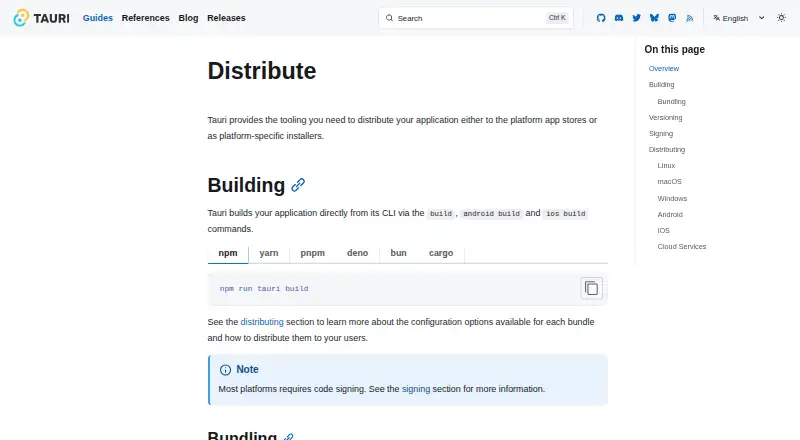
Tauri Bundler is free Rust tooling for packaging applications as operating-system bundles and installers. Its build command bundles an application for its configured formats by default, with separate build and bundle steps available when customization is needed. Distribution documentation covers Linux, macOS, Windows, Android, and iOS. Linux options include Debian, Snap, AppImage, Flatpak, RPM, and AUR; macOS apps can go through the App Store or be distributed as DMG installers. The guides also cover the Microsoft Store, Google Play, and the iOS App Store. Build instructions show commands for npm, yarn, pnpm, Deno, Bun, and Cargo, and Tauri documents a GitHub pipeline for building and releasing applications. Tauri describes the tooling as frontend-agnostic and says most frameworks work out of the box. However, it acts as a static web host and does not natively support server-based frontend alternatives such as SSR. Code signing is required on most platforms; macOS distribution outside the App Store also requires notarization. Tauri says major and minor releases undergo security audits. The bundler's public API is intended primarily for tauri-cli and does not strictly follow SemVer.
Who it is for
It suits developers packaging Tauri applications for desktop and mobile stores or direct distribution. Teams using server-rendered frontend approaches should note the static-host limitation.
What is good
- Free Rust library
- Packages for desktop and mobile platforms
- Supports several Linux distribution formats
- Build instructions cover six toolchains
- Security audits cover major and minor releases
What to know first
- Does not natively support server-based frontend alternatives
- Code signing is required on most platforms
- macOS outside the App Store requires notarization
- Public API does not strictly follow SemVer
Specifiction review
Tauri Bundler: the full review
Tauri Bundler covers packaging and distribution across desktop and mobile targets, with multiple Linux formats and store routes. Its frontend hosting constraint, signing requirements, and API stability caveat matter when planning a build.
Overview
Tauri Bundler suits teams building applications with Tauri who need one packaging workflow across desktop and mobile targets. Its breadth of distribution routes is a strong fit for multi-platform releases, but signing work and a static-only frontend host make it a poor match for every project.
The Rust library wraps executables in platform-specific app bundles; most users reach it through Tauri CLI commands. The default build command builds and bundles configured formats together, while separate build and bundle steps allow more tailored workflows. Settings can live in the bundle object of tauri.conf.json. The library can also serve non-Tauri apps, but its public API is intended mainly for tauri-cli and does not strictly follow Semantic Versioning, so direct integrations should account for potential API changes.
Key features
Packaging and release workflow
Build instructions cover npm, yarn, pnpm, Deno, Bun, and Cargo, and Tauri documents a GitHub pipeline for building and releasing applications. That combination suits teams already using those ecosystems and CI; it does not remove the work of configuring release credentials or signing.
Linux packages include Debian, Snap, AppImage, Flatpak, RPM, and AUR. macOS distribution routes include the App Store and direct-download DMG installers; Windows guidance covers the Microsoft Store and installers. Android releases are documented through Google Play, and iOS releases through the App Store. This range is valuable when one product needs several delivery channels, though each route brings its own platform requirements.
Frontend and security
Tauri is frontend agnostic and supports most frameworks out of the box, but it serves static web content rather than server-based frontends such as SSR. Projects dependent on server rendering need another architecture or a different tool. Capabilities can grant or deny permissions for selected windows and webviews, giving teams a way to constrain frontend access. Tauri says major and minor releases receive security audits covering its organization code and upstream dependencies.
Signing and distribution
Code signing is required on most platforms. It digitally signs executables and bundles to validate the provider's identity, so release teams must plan for signing credentials and platform-specific steps. macOS distribution also requires signing, and distributing outside the App Store requires notarization. Cloud services are described as supporting global distribution and automatic updates, with CrabNebula Cloud linked as an option.
Pricing
Tauri Bundler is free: 0.00 USD per free. The plan is an open-source Rust library that wraps Rust executables in operating-system-specific bundles. There is no paid tier to trade off against, making it suitable for projects that want command-line packaging without a bundler license fee. The trade-off for developers using the library directly is its non-SemVer public API; teams relying on Tauri CLI avoid making that API their primary integration surface.
Platforms
The target platforms are Linux, macOS, Windows, Android, and iOS. Packaging is command-line based, with silent installation, auto-update support, and CI/CD integration among the listed capabilities. The breadth is useful for cross-platform release planning, but it does not make the signing requirements disappear.
Who it's for
Choose Tauri Bundler if you are building with Tauri and want a free route to package for several desktop and mobile operating systems, with multiple Linux formats and store distribution guidance. It is also a reasonable option for non-Tauri applications whose developers can accommodate a less stable direct library API. Look elsewhere if your frontend requires SSR or if you need a stable standalone bundler API as a core dependency.
Pros and cons
- Pros: Five target platforms and six Linux formats support varied distribution strategies without a bundler charge.
- Pros: The default build workflow bundles configured formats, while separate build and bundle steps leave room for customization.
- Pros: Build guidance spans common JavaScript runtimes and Cargo, with documented GitHub CI integration.
- Cons: Static hosting rules out native SSR frontends, constraining framework architecture.
- Cons: Signing is required on most platforms, and macOS direct distribution adds notarization.
- Cons: The public API does not strictly follow SemVer, which raises maintenance risk for direct integrations.
Alternatives
Consider Software Packaging Tools to compare the broader category. electron-builder is another free option for Linux, macOS, and Windows if your targets are desktop-only. InstallAware offers a free Visual Studio edition for commercial use across Linux, macOS, and Windows, with a free trial also available. Advanced Installer has a free Windows-only freeware tier for Simple projects and a free trial; it is a fit when that project scope suits your packaging needs. InstallBuilder is a paid, trial-available choice for Linux, macOS, and Windows if you prefer a commercial installer product. Jamf Safe Internet is a paid, trial-available option spanning iOS, macOS, web, and Windows, oriented to education management, network threat prevention, and content filtering. install4j offers a multi-platform perpetual license with custom pricing and an optional year of support and upgrades. IzPack is a free Apache License 2.0 alternative for Linux, macOS, self-hosted environments, and Windows. WiX Toolset provides freely available source code for Windows-focused packaging.
Verdict
Tauri Bundler is the right choice for Tauri teams that want free packaging across desktop and mobile, particularly when several Linux formats or store routes matter. Its broad targets and integrated build workflow are compelling; choose another approach if SSR is essential or direct use demands a stable public API.
Tauri Bundler plans and pricing
All plansCompared on software packaging tools
- Free plan
- Yestauri.app
- Target platforms
- Linux, macOS, Windows, Android, iOStauri.app
- Output formats
- AppImage, Debian, RPM, Flatpak, Snap, AUR, DMG, macOS .app, MSI, NSIS .exetauri.app
- Command-line packaging
- Yestauri.app
- Silent installation
- Yestauri.app
- Auto-update support
- Yestauri.app
- CI/CD integration
- Yestauri.app
Facts
- Purpose
- Tauri provides tooling to build and distribute applications through app stores or as platform-specific installers.tauri.app · 30 Sept 2026
- Build CLI
- Applications can be built with Tauri CLI commands, including `build`, `android build`, and `ios build`.tauri.app · 30 Sept 2026
- Bundling
- The `build` command bundles an application for its configured formats by default, with separate build and bundle steps available for customization.tauri.app · 30 Sept 2026
- Linux formats
- Linux distribution formats listed include Debian, Snap, AppImage, Flatpak, RPM, and AUR.tauri.app · 30 Sept 2026
- macOS distribution
- macOS apps can be distributed through the App Store or as direct-download DMG installers.tauri.app · 30 Sept 2026
- Other stores
- The distribution guides cover the Microsoft Store for Windows, Google Play for Android, and the App Store for iOS.tauri.app · 30 Sept 2026
- Code signing
- Tauri says code signing is required on most platforms, and macOS distribution outside the App Store also requires notarization.tauri.app · 30 Sept 2026
- Frontend compatibility
- Tauri describes itself as frontend agnostic and says it supports most frontend frameworks out of the box.tauri.app · 30 Sept 2026
- Frontend limitation
- Tauri acts as a static web host and does not natively support server-based frontend alternatives such as SSR.tauri.app · 30 Sept 2026
- Security controls
- Tauri capabilities can grant or deny permissions for selected windows and webviews to constrain frontend access.tauri.app · 30 Sept 2026
- Security audits
- Tauri says major and minor releases undergo security audits that cover Tauri organization code and upstream dependencies.tauri.app · 30 Sept 2026
- Support
- The prerequisites guide directs users with installation issues to the troubleshooting guide or Tauri Discord.tauri.app · 30 Sept 2026
- Governance
- The Tauri Programme within the Commons Conservancy was established to support Tauri's open-source values and facilitate transparent governance.tauri.app · 30 Sept 2026
- Build workflow
- Tauri's build command automatically bundles an application for its configured formats by default.tauri.app · 30 Sept 2026
- Desktop distribution
- The documentation covers macOS App Store and DMG distribution, plus Microsoft Store and Windows installer distribution.tauri.app · 30 Sept 2026
- Mobile distribution
- Tauri documents Android distribution through Google Play and iOS distribution through the App Store.tauri.app · 30 Sept 2026
- Build integrations
- The build instructions show npm, yarn, pnpm, Deno, Bun, and Cargo commands for building Tauri applications.tauri.app · 30 Sept 2026
- CI integration
- Tauri documents a GitHub pipeline for building and releasing Tauri applications.tauri.app · 30 Sept 2026
- Cloud delivery
- The distribution guide describes cloud services as supporting global app distribution and automatic updates, and links to CrabNebula Cloud.tauri.app · 30 Sept 2026
- Signing
- Tauri says code signing digitally signs application executables and bundles to validate the provider's identity, and is required on most platforms.tauri.app · 30 Sept 2026
- macOS requirement
- Tauri says macOS distribution requires code signing, and distribution outside the App Store also requires notarization.tauri.app · 30 Sept 2026
- API stability
- The bundler README says its public API does not strictly adhere to SemVer because it is intended primarily for use in tauri-cli.github.com · 30 Sept 2026
- Configuration
- Tauri can load bundler settings from the bundle object in tauri.conf.json, while the library can also be used by non-Tauri apps.github.com · 30 Sept 2026
Best Tauri Bundler alternatives
See all 20




Where it ranks on Specifiction
Is Tauri Bundler yours?
Claim it for free: prove the domain, then correct facts, plans and screenshots. An editor reviews every change.
Sources
- tauri.app/distribute/· checked 30 Sept 2026
- tauri.app/start/frontend/· checked 30 Sept 2026
- tauri.app/security/capabilities/· checked 30 Sept 2026
- tauri.app/start/· checked 30 Sept 2026
- tauri.app/start/prerequisites/· checked 30 Sept 2026
- tauri.app/about/governance/· checked 30 Sept 2026
- tauri.app/distribute/pipelines/github/· checked 30 Sept 2026
- github.com/tauri-apps/tauri/blob/dev/crates/tauri-· checked 30 Sept 2026