
- 1Runs onAndroid, API, iOS, Web
- 2CostsFree plan · paid from $45/mo
- 3Semantic searchYes
- 4Claim analysisYes
- 5Patent clusteringYes
- 6Patent family analysisYes
- 7Jurisdictions covered5
Overview
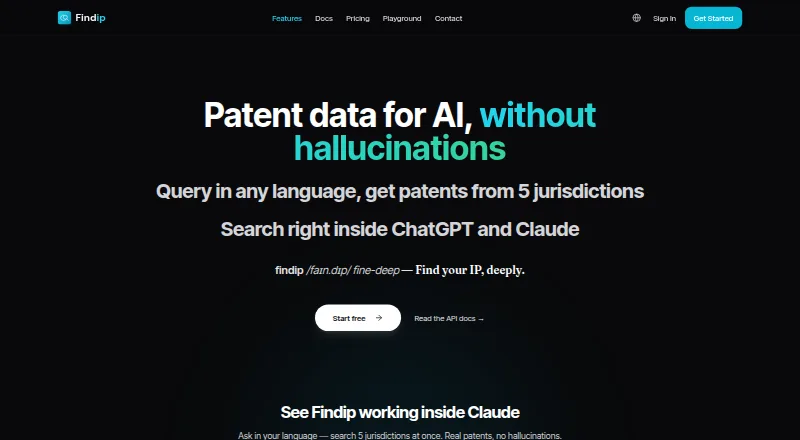
FindIP provides patent search through a browser playground and a REST API for use in other services. It searches published patents from the US, China, Japan, Korea, and Europe; full-text coverage begins in 2001, except China, where it begins in 2010. Semantic search matches text by meaning, while drawing search finds visually similar patent illustrations. Sequence search covers similar DNA, RNA, or protein sequences. Image and sequence results can be reranked by topic. Queries may be written in English, Korean, Japanese, Chinese, or German across all five jurisdictions. FindIP says each result is a publication in its database that can be checked by publication number. Its MCP connection supports Claude Desktop and Web and ChatGPT during beta. The Free plan costs 0.00 USD per free and includes 30 search credits and all APIs. Basic costs 45.00 USD per month, billed excluding tax, and includes 300 monthly credits. Text searches use one credit; image search, sequence search, and trend analysis use two. The listed rate limit is 60 requests per minute on Free, Basic, and Pro; Enterprise has a custom limit.
Who it is for
FindIP suits researchers and teams searching patents across multiple jurisdictions, including those who want semantic, drawing, or biological-sequence search. Its REST API and MCP connection also suit users integrating patent search into services or supported AI tools.
What is good
- Search across five patent jurisdictions.
- Semantic, drawing, and sequence search options.
- Queries supported in five languages.
- REST API and MCP connection available.
- Free plan includes 30 search credits.
What to know first
- Unpublished patents are excluded.
- China full-text coverage starts in 2010.
- API keys are issued on request.
- Free plan includes 30 search credits.
Specifiction review
FindIP: the full review
FindIP combines several patent search methods with API access and broad jurisdiction and language coverage. Its published-data boundary and credit costs are important constraints to weigh before choosing a plan.
FindIP is a patent-search service with a browser playground and a REST API for AI workflows. It is best suited to researchers and product teams that need semantic, drawing, or biological-sequence search across five patent jurisdictions. Its range of search methods is compelling, but published-data coverage and credit limits define its reach.
Overview
FindIP searches published patents from the US, China, Japan, Korea, and Europe. Full-text coverage starts in 2001, except in China, where it starts in 2010. Queries can be written in English, Korean, Japanese, Chinese, or German and searched across all five jurisdictions. FindIP says every result is an existing publication in its database, verifiable by publication number—a useful check when search results feed a research workflow.
The key boundary is the data itself: unpublished patents are excluded. FindIP also covers five jurisdictions, so it is not the right choice when a search depends on unpublished filings or offices beyond that set.
Key features
Search by meaning, drawing, or sequence
Semantic search matches text by meaning rather than exact keywords, which can help when relevant patents use different terminology. Drawing search finds visually similar patent illustrations, and adding text can steer ranking toward a topic. Sequence search identifies similar DNA, RNA, or protein sequences, with optional topic-based reranking. These methods make FindIP more suitable for varied discovery tasks than a keyword-only workflow, though their credit costs make frequent specialized searches more expensive to budget.
API and AI connections
A browser-based playground supports direct exploration, while REST API access lets teams embed search in other services. API keys are issued on request, with the endpoint reference provided when a key is issued. FindIP's MCP connection officially supports Claude Desktop and Web, and ChatGPT during beta, through the shared endpoint mcp.findip.ai. Details, drawings, document fetches, and MCP resources cost no credits; text searches cost one credit, while image search, sequence search, and trend analysis cost two.
Claim analysis, patent clustering, and patent family analysis are also supported. The listed rate limit is 60 requests per minute on Free, Basic, and Pro; Enterprise uses a custom limit.
Pricing
The Free plan costs 0.00 USD per free and includes 30 search credits, all APIs, five jurisdictions, and reranking. It is a useful way to explore the service, but 30 credits constrain sustained searching, particularly if image or sequence queries are part of the workflow.
Basic costs 45.00 USD per month, billed Excl. tax, for 300 search credits/month, all APIs, five jurisdictions, reranking, and email support. It fits an individual who needs a larger allowance and support. Team Basic costs the same 45.00 USD per month, billed Excl. tax, and provides 300 search credits/member/month, a team dashboard, unified billing, self-service seat changes, and five jurisdictions. It is the more relevant entry point for teams, though its listed inclusions do not mention all APIs or reranking.
Pro costs 135.00 USD per month, billed Excl. tax, and includes 1,000 search credits/month for a single user, all APIs, five jurisdictions, reranking, and priority support. It suits an individual with heavier search needs who values faster support. Team Pro costs 135.00 USD per month, billed Excl. tax, and supplies 1,000 search credits/member/month, a team dashboard, unified billing, self-service seat changes, and priority support. Per-member credits and seat changes make it the team option for larger workloads; the listed inclusions do not mention all APIs or reranking.
Enterprise has custom search credits and pricing, with a custom contract and billing, negotiated support, and features and infrastructure by agreement. It is for organizations that need individually agreed terms or a custom rate limit. The Free plan lists community support; Basic includes email support, Pro priority support, and Enterprise negotiated support. Contact [email protected] for product, technical, billing, and API inquiries.
Platforms
FindIP is available on web, iOS, and Android, alongside API access. The browser playground offers a direct way to search, while the API is the fit for embedding patent search into another service.
Who it's for
FindIP is a strong fit for patent researchers, product teams, and AI developers who need multilingual semantic search or specialist drawing and sequence search, and who can work within published records across its five jurisdictions. It is less suitable for searches requiring unpublished filings or broader jurisdiction coverage, and credit-based pricing deserves close attention for frequent image or sequence use.
Pros and cons
- Pros: Semantic, drawing, and biological-sequence search support different discovery problems beyond exact text matching.
- Pros: Five-language queries cover five jurisdictions, with publication-number verification for results.
- Pros: All APIs are included on Free, Basic, and Pro, making it possible to explore or integrate without reserving API access for the highest tier.
- Cons: Published-office data excludes unpublished patents, a hard limitation for workflows that need them.
- Cons: Free has only 30 credits, and image, sequence, and trend searches consume two credits each.
- Cons: Paid individual plans are billed Excl. tax, and Enterprise pricing and rate limits are custom.
Alternatives
AI Patent Search Software is the category list to consult when comparing patent-search tools more broadly.
Choose GoVeda instead if its free OpenPatent offer of 220M+ patents worldwide and unlimited AI semantic searches better matches a need for broader stated coverage without a credit allowance. PatSnap is another option; its free Basic plan covers limited technical topics, AI technical Q&A, TRIZ innovation generation, and trial technical research reports.
The Lens offers free anonymous browsing and a free Academic Workspace for eligible academic users doing non-commercial work. AcclaimIP uses annual, prepaid per-seat licensing with pricing provided by quote, so it may suit buyers who prefer a license quote and seat-based terms.
Patently has a free individual plan with asset search, Onardo chat, patent-family browsing, and shareable asset links. XLSCOUT is another paid option with an API and web platform. IP.com InnovationQ+ offers a two-day free trial. IPRally offers paid plans with API, self-hosted, and web platforms, and a free trial.
Verdict
Choose FindIP if your work benefits from semantic, drawing, or sequence search across its five jurisdictions and you want browser access or an API for AI workflows. Its range of search modes and entry-level free plan are the case for it; look elsewhere if unpublished records or coverage beyond those jurisdictions are essential, or if the credit allowance would constrain your search volume.
FindIP plans and pricing
All plansCompared on AI patent search software
Facts
- Product
- Findip provides patent search for AI workflows and a browser-based playground, with a REST API for embedding search in other services.findip.ai · 28 Sept 2026
- Coverage
- It covers published patents from the US, China, Japan, Korea, and Europe; full-text search covers publications from 2001 onward, and China from 2010.findip.ai · 28 Sept 2026
- Languages
- Queries can be made in English, Korean, Japanese, Chinese, or German and search across all five jurisdictions.findip.ai · 28 Sept 2026
- Verified results
- Findip says each result is an existing publication in its database and can be checked by publication number.findip.ai · 28 Sept 2026
- Drawing search
- Image search finds patents with visually similar drawings and can combine an image with text to rank results by topic.findip.ai · 28 Sept 2026
- Sequence search
- Sequence search finds patents with similar DNA, RNA, or protein sequences, optionally reranking matches by topic.findip.ai · 28 Sept 2026
- Integrations
- Findip's MCP connection officially supports Claude (Desktop and Web) and ChatGPT during beta; the shared MCP endpoint is mcp.findip.ai.findip.ai · 28 Sept 2026
- API access
- REST API keys are issued on request, and the endpoint reference is provided when an API key is issued.findip.ai · 28 Sept 2026
- Credit usage
- Text search costs one credit; image search, sequence search, and trend analysis cost two, while details, drawings, document fetches, and MCP resources cost zero.findip.ai · 28 Sept 2026
- Rate limit
- The listed rate limit is 60 requests per minute on Free, Basic, and Pro plans; Enterprise has a custom limit.findip.ai · 28 Sept 2026
- Data limitation
- Coverage is based on published office data, so unpublished patents are excluded.findip.ai · 28 Sept 2026
- Support
- The pricing page lists community support for Free, email support for Basic, priority support for Pro, and custom support scope for Enterprise.findip.ai · 28 Sept 2026
- Contact
- Findip lists [email protected] for product, technical, billing, and API inquiries.findip.ai · 28 Sept 2026
Best FindIP alternatives
See all 20

Where it ranks on Specifiction
Is FindIP yours?
Claim it for free: prove the domain, then correct facts, plans and screenshots. An editor reviews every change.
Sources
- findip.ai/en· checked 28 Sept 2026
- findip.ai/en/docs/data-coverage· checked 28 Sept 2026
- findip.ai/en/docs/features/multilingual· checked 28 Sept 2026
- findip.ai/en/docs/features/verifiable· checked 28 Sept 2026
- findip.ai/en/docs/features/image-search· checked 28 Sept 2026
- findip.ai/en/docs/features/sequence-search· checked 28 Sept 2026
- findip.ai/en/docs/connect· checked 28 Sept 2026
- findip.ai/en/docs/dev-guide· checked 28 Sept 2026
- findip.ai/en/pricing· checked 28 Sept 2026
- findip.ai/en/contact· checked 28 Sept 2026