SagaOS Kea Pilot
- 1Runs onAPI, Linux, self-hosted, Web
- 2CostsFree plan
- 3Deploymenton-premises
- 4Reservation managementYes
- 5DHCPv6 supportYes
- 6DHCP failoverYes
- 7REST APIYes
- 8Audit logsYes
Overview
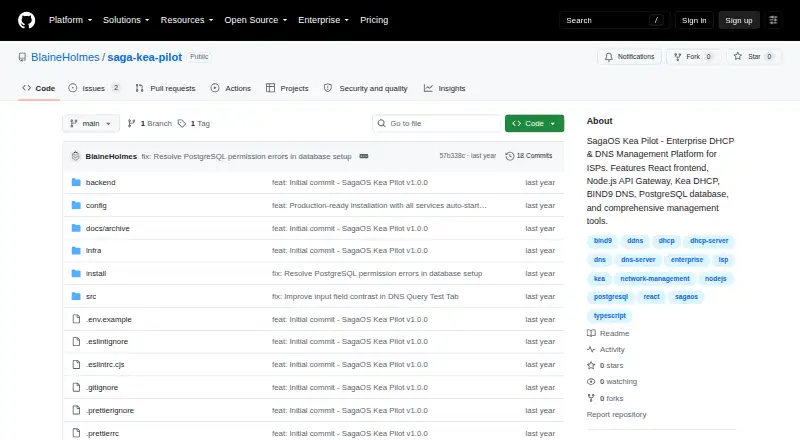
SagaOS Kea Pilot is a web management platform for Kea DHCP, BIND9 DNS, and Dynamic DNS, aimed at ISP and enterprise network operations. It manages DHCPv4 and DHCPv6 subnets, address pools, host reservations, leases, options, and Kea high availability. For DNS, it handles BIND9 zones and records, RFC2136 dynamic updates, and synchronization with DHCP lease events. A live health dashboard, WebSocket updates, service status tracking, performance metrics, audit logs, and analytics support operational monitoring. The platform also lists multi-tenant data isolation and granular role-based access control, with REST endpoints for DHCP and DNS operations. Configuration tools cover backup, restore, versioning, and rollback. Deployment is documented for Linux and Docker, with Ubuntu 20.04+, CentOS 8+, RHEL 8+, and Debian 11+ listed. Minimum requirements are 2 CPU cores, 4 GB RAM, and 20 GB SSD; BIND9 is optional in the minimal installation. The software is MIT licensed and free. The README documents admin/admin as the initial login and says it must be changed for production.
Who it is for
SagaOS Kea Pilot suits ISP and enterprise network operators managing DHCP and DNS services. It is intended for Linux or Docker deployments and lists multi-tenant access controls and operational monitoring.
What is good
- Manages DHCPv4 and DHCPv6, including reservations.
- Supports BIND9 zones and DHCP-linked DDNS synchronization.
- Includes audit logs, analytics, and live status updates.
- MIT licensed with no paid tiers stated.
What to know first
- Minimum listed requirements are 2 CPU cores and 4 GB RAM.
- Initial login is admin/admin and must be changed for production.
- BIND9 is optional in the minimal installation.
Verdict
SagaOS Kea Pilot combines DHCP and DNS management with monitoring, access controls, and configuration rollback tools. Change the documented initial credentials before production use, and plan for the stated minimum system requirements.
SagaOS Kea Pilot plans and pricing
All plansCompared on DHCP management software
- Deployment
- on-premisesgithub.com
- Reservation management
- Yesgithub.com
- DHCPv6 support
- Yesgithub.com
- DHCP failover
- Yesgithub.com
- REST API
- Yesgithub.com
- Audit logs
- Yesgithub.com
Facts
- Purpose
- The project describes itself as a web management platform for Kea DHCP, BIND9 DNS, and Dynamic DNS, aimed at ISP and enterprise network operations.github.com · 30 Sept 2026
- DHCP
- It supports DHCPv4 and DHCPv6 management, including subnets, address pools, host reservations, leases, DHCP options, and Kea high availability.github.com · 30 Sept 2026
- DNS
- It provides BIND9 zone and record management, RFC2136 dynamic updates, and DDNS synchronization with DHCP lease events.github.com · 30 Sept 2026
- Monitoring
- The project lists a live health dashboard, WebSocket updates, service status tracking, performance metrics, audit logging, and analytics.github.com · 30 Sept 2026
- Access control
- It lists multi-tenant support, data isolation, and role-based access control with granular permissions.github.com · 30 Sept 2026
- API
- It provides REST API endpoints for DHCP and DNS operations and WebSocket events for live updates.github.com · 30 Sept 2026
- Integrations
- The documented stack includes Kea DHCP, BIND9, PostgreSQL, Docker, and Nginx; BIND9 is optional in the minimal installation.github.com · 30 Sept 2026
- Security
- Listed security measures include CSRF protection, input validation, secure sessions, SQL injection prevention, XSS protections, rate limiting, and audit logging.github.com · 30 Sept 2026
- Authentication
- The README says the project supports TOTP and hardware-token multi-factor authentication as an enterprise feature.github.com · 30 Sept 2026
- Requirements
- The listed minimum system requirements include 2 CPU cores, 4 GB RAM, and 20 GB SSD storage.github.com · 30 Sept 2026
- License
- The repository states that the software is MIT licensed and permits commercial use, modification, and distribution; it also provides the software without warranty.github.com · 30 Sept 2026
- Support
- The README directs users to GitHub Issues, its documentation and community discussions, and says commercial support is available for enterprise deployments and custom integrations.github.com · 30 Sept 2026
- Initial credentials
- The README documents admin/admin as the default login and says it must be changed for production.github.com · 30 Sept 2026
- Access controls
- It lists multi-tenant data isolation and role-based access control with granular permissions and user management.github.com · 30 Sept 2026
- Configuration
- Configuration tools include backup, restore, versioning, and rollback.github.com · 30 Sept 2026
- Authentication caveat
- The documented initial credentials are admin/admin, and the README says to change them for production.github.com · 30 Sept 2026
- System requirements
- The README specifies at least 2 CPU cores, 4 GB RAM, and 20 GB SSD, with higher recommendations for production.github.com · 30 Sept 2026
Best SagaOS Kea Pilot alternatives
See all 19

Where it ranks on Specifiction
Is SagaOS Kea Pilot yours?
Claim it for free: prove the domain, then correct facts, plans and screenshots. An editor reviews every change.
Sources
- github.com/BlaineHolmes/saga-kea-pilot· checked 30 Sept 2026