
- 1Runs onAndroid, API, iOS, Web
- 2CostsFree plan · paid from $0.75/mo
- 3Virtual cardsYes
- 4Issuing APIYes
- 5Spend controlsYes
- 6Funding and balancesYes
- 7Card program supportmulti
- 8KYC/KYB toolsYes
Overview
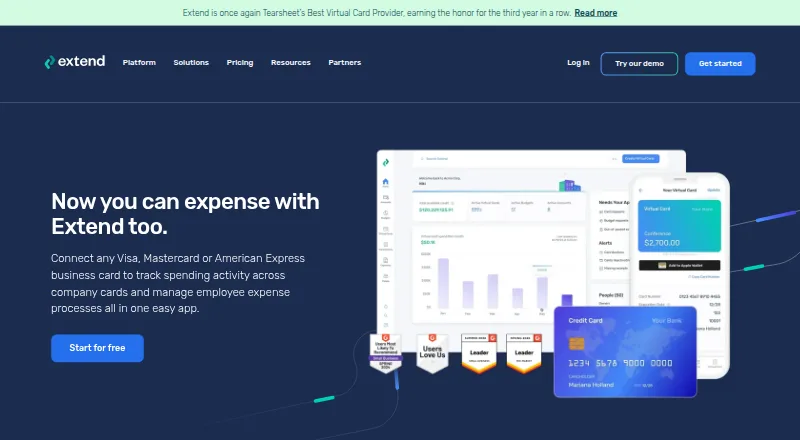
Extend manages company card spending and employee expenses with virtual cards, expense tracking, receipt management, and accounting reconciliation. Virtual cards can carry spending limits and expiration dates for vendor payments, subscriptions, or team expenses. Card creation is available only through participating bank partners; eligible Visa or Mastercard cards from other banks can be registered for expense management. Other tools include budgets, receipt capture, expense reports, reimbursements, approval workflows, and transaction reporting. Integrations include QuickBooks Online and Desktop, NetSuite, Xero, Sage Intacct, and Microsoft Dynamics 365 Business Central. The virtual card API supports issuance, transaction metadata, real-time authorization and clearing data through webhooks, and configurable card controls. Extend says it is PCI and SOC 2 compliant and uses TLS with SHA-256 and RSA encryption. Starter is free for up to five users and 100 virtual cards per month. Pro costs $8.99/user/mo (annual) or $11.99/user/mo (monthly), with a 10-user minimum for either option.
Who it is for
Extend suits companies seeking to manage spending and employee expenses, including teams that use virtual cards and accounting integrations. Its business platform is described as serving companies of all sizes, though Pro has a 10-user minimum.
What is good
- Virtual cards support spending limits and expiration dates
- Expense tools include reimbursements and approvals
- Integrates with six listed accounting platforms
- Free Starter supports up to five users
What to know first
- Virtual card creation requires a participating bank partner
- Pro requires a 10-user minimum
- Starter is limited to 100 virtual cards monthly
Specifiction review
Extend: the full review
Extend combines card controls, expense workflows, and accounting integrations, with a free entry plan and two listed Pro billing options. Check bank-partner availability and the Pro minimum before settling on a plan.
Overview
Extend is a company-spending and employee-expense platform for businesses that want card controls and expense administration together. It is best suited to teams with a participating bank partner and a supported accounting system; small teams should weigh the Pro plan’s 10-user minimum carefully.
Its combination of virtual cards, expense workflows, and accounting connections is useful, but card issuance depends on bank-partner eligibility and the paid tier is sized for larger teams.
Key features
Virtual cards and controls
Teams can create virtual cards for vendors, subscriptions, or employee expenses, with spending limits and expiration dates. That helps bound delegated or recurring spending. The important constraint is issuer access: card creation is limited to participating bank partners. Eligible Visa or Mastercard cards from other banks can be registered for expense management, but not for Extend virtual card issuance.
Extend supports funding and balances, spend controls, and multi-card programs. Its virtual card API supports issuance, configurable controls, and transaction metadata, with real-time authorization and clearing data delivered through webhooks. That makes it relevant to businesses building card workflows into their own systems, while Enterprise is the tier that provides virtual card issuance by API key.
Expense workflows and integrations
Budgets, receipt capture, expense reports, reimbursements, approval workflows, and transaction reporting cover much of the work that follows a company purchase. Connections to QuickBooks Online and Desktop, NetSuite, Xero, Sage Intacct, and Microsoft Dynamics 365 Business Central make Extend a stronger fit for organizations already using one of those accounting platforms.
Privacy and support
Extend says only a virtual card’s designated recipient can view its full number; the primary cardholder and organization administrators see only the last four digits in the app and reports. The company says it is PCI and SOC 2 compliant and uses TLS with SHA-256 and RSA encryption. Starter has email and chat support; Pro adds priority support, while Enterprise includes an account manager and custom implementation. A help center, onboarding support, webinars, and learning resources supplement those plan-level services.
Pricing
Starter is free and supports up to 5 users, 10 guests, and 100 virtual cards per month. Its one expense category and 15 category labels suit a small team with basic needs, but the category cap may be limiting for businesses that organize expenses across several departments or purposes.
Pro (annual) costs 8.99 USD per user, per month on the annual plan, with a 10-user minimum. Pro (monthly) costs 11.99 USD per user, per month, also with a 10-user minimum. Both allow up to 50 guests, 500 virtual cards per month, five expense categories, and 500 category labels. Pro raises the card and category limits and adds priority support, but the minimum means even a smaller team must pay for at least 10 users to use it. The annual option has the lower per-user monthly rate; the monthly option avoids the annual billing term.
Enterprise has custom pricing, no user minimum, custom user packages, virtual card issuance by API key, and unlimited expense categories and labels. It is the fit for organizations that need tailored scale or API-based issuance rather than Pro’s fixed limits. There is no free trial.
Platforms
Extend supports Android, iOS, and web, and offers an API. The API makes it possible to integrate card issuance and transaction data into a business’s own systems, while the mobile apps provide access to the expense and card workflows.
Who it's for
Extend is a sensible choice for businesses that can use a participating issuer, want card controls alongside expense administration, and rely on one of its accounting integrations. Starter is the lower-risk option for a team of five or fewer that can work within its monthly card and category caps. Pro is better suited to teams large enough to absorb its 10-user minimum and that need more cards, guests, or expense categories. Businesses that need custom packages or API-key issuance should consider Enterprise; those without an eligible issuing partner should not choose Extend for virtual card creation.
Pros and cons
- Broad expense coverage: receipts, reports, reimbursements, approvals, and budgets sit alongside card controls, reducing the need to separate these workflows.
- Useful accounting reach: integrations span QuickBooks, NetSuite, Xero, Sage Intacct, and Microsoft Dynamics 365 Business Central.
- Meaningful free entry tier: Starter has no charge and supports five users, but its 100-card monthly cap and single expense category constrain growth.
- Paid tier minimum: Pro expands card capacity to 500 per month and categories to five, but requires at least 10 users.
- Issuer dependency: virtual card creation is only available through participating bank partners, limiting its usefulness for businesses outside those programs.
Alternatives
For a broader Card Issuing Platforms comparison, start with the category directory. Paynetics Card Issuing is worth considering when customisable programmes and physical as well as virtual Visa or Mastercard cards matter. Marqeta is a paid enterprise platform for teams focused on API and web access. Mastercard Decision Intelligence is another paid, web-based option.
OpenWay Way4 is an alternative with API, web, and self-hosted platforms. Enfuce Cards may suit programmes whose costs are scoped to implementation, monthly service, and volume. Lithic uses custom quotes based on transaction volume and required features. Nium Physical and Virtual Cards is another paid card-program option with custom terms. Highnote is a paid API and web choice with an Issuing Standard plan that describes volume discounts, interchange split, and a dedicated programme manager.
Verdict
Choose Extend if your business has access to a participating bank partner and wants virtual card controls, employee expense workflows, and accounting integrations in one service. Starter offers a practical free entry point, but the Pro 10-user minimum and issuer restriction are decisive drawbacks for smaller teams or businesses seeking independent virtual card issuance.
Extend plans and pricing
All plansCompared on card issuing platforms
- Free plan
- Yespaywithextend.com
- Virtual cards
- Yespaywithextend.com
- Issuing API
- Yespaywithextend.com
- Spend controls
- Yespaywithextend.com
- Funding and balances
- Yespaywithextend.com
- Card program support
- multipaywithextend.com
- KYC/KYB tools
- Yespaywithextend.com
Facts
- Product
- Extend manages company credit card spending and employee expenses, with virtual cards, expense tracking, receipt management, and accounting reconciliation.paywithextend.com · 28 Sept 2026
- Issuer availability
- Virtual card creation is available only with participating bank partners; eligible Visa or Mastercard cards from other banks can be registered for expense management features.paywithextend.com · 28 Sept 2026
- Expense tools
- Extend offers budgets, receipt capture, expense reports, reimbursements, approval workflows, and transaction reporting.paywithextend.com · 28 Sept 2026
- Integrations
- Extend lists integrations with QuickBooks Online and Desktop, NetSuite, Xero, Sage Intacct, and Microsoft Dynamics 365 Business Central.paywithextend.com · 28 Sept 2026
- API
- Extend's virtual card API supports card issuance, transaction metadata, real-time authorization and clearing data through webhooks, and configurable card controls.paywithextend.com · 28 Sept 2026
- Security
- Extend says it is PCI and SOC 2 compliant and uses TLS with SHA-256 and RSA encryption to protect data.paywithextend.com · 28 Sept 2026
- Virtual card privacy
- Extend says only the designated recipient can see a virtual card's full number, while the primary cardholder and organization admins see its last four digits in the app and reports.paywithextend.com · 28 Sept 2026
- Support
- Starter includes email and chat support, Pro includes priority support, and Enterprise includes a designated account manager and custom implementation.paywithextend.com · 28 Sept 2026
- Customer help
- Extend provides a help center, onboarding support, webinars, and learning resources.paywithextend.com · 28 Sept 2026
- Who it serves
- Extend describes its business platform as serving companies of all sizes and helping businesses manage company spending and employee expenses.paywithextend.com · 28 Sept 2026
Company
- Headquarters
- New York City, New York, United Statespaywithextend.com · 28 Sept 2026
- Founded
- Extend says it was founded in 2017 by payment industry veterans.paywithextend.com · 28 Sept 2026
Best Extend alternatives
See all 19


Where it ranks on Specifiction
Is Extend yours?
Claim it for free: prove the domain, then correct facts, plans and screenshots. An editor reviews every change.
Sources
- paywithextend.com/faqs· checked 28 Sept 2026
- paywithextend.com/pricing· checked 28 Sept 2026
- paywithextend.com/app-features· checked 28 Sept 2026
- paywithextend.com/guides/expense-codes-integrations· checked 28 Sept 2026
- paywithextend.com/solutions/integrated-payments· checked 28 Sept 2026
- paywithextend.com/guides/virtual-cards· checked 28 Sept 2026
- paywithextend.com/guides/support· checked 28 Sept 2026
- paywithextend.com/company· checked 28 Sept 2026
- paywithextend.com· checked 28 Sept 2026
- paywithextend.com/resource/how-to-send-a-virtual-card· checked 28 Sept 2026