- 1Runs onAPI, Linux, self-hosted, Web
- 2CostsFree plan · free trial · paid from $99/mo
- 3Matching automationrules
- 4Exception workflowsYes
- 5Approval controlsYes
Overview
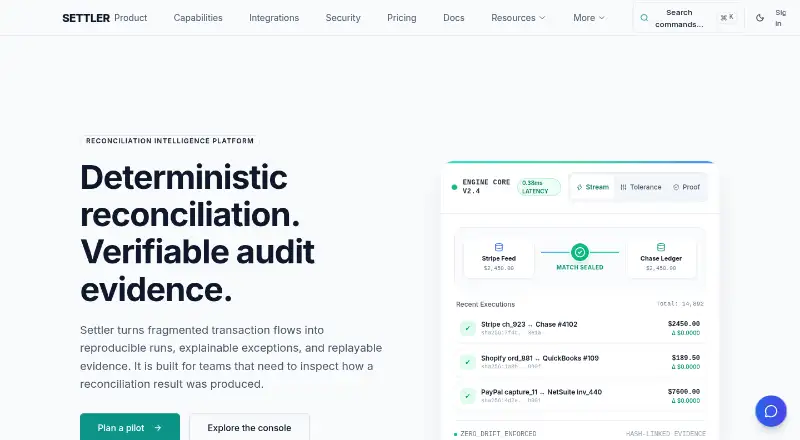
Settler is API-first financial reconciliation software that turns transaction flows into repeatable runs, explainable exceptions, and replayable evidence. Its rules-as-code engine applies configurable policies and field-level tolerances so the same inputs produce consistent results. Runs can generate linked-hash manifests, provenance chains, structured evidence, and audit export bundles. Exception records include deterministic context and operator decisions; AI assistance is advisory, with people retaining final authority. Listed adapters include Stripe, PayPal, Square, Shopify, QuickBooks, Xero, NetSuite, SAP, Plaid, TrueLayer, and Chargebee, with 14 more stated on the page. The API supports tenant-scoped runs, evidence retrieval, replay, and health checks. Settler can be self-hosted with Docker Compose or Kubernetes, and its self-hosted mode has no telemetry by default and uses the Apache 2.0 license. Open Source is free and limited to 10,000 monthly reconciliations; Cloud API costs $99.00 USD per month and Managed Operations costs $399.00 USD per month. Settler says it is not a compliance certification.
Who it is for
Settler suits finance and risk teams that need repeatable reconciliation and traceable exception review, as well as developers and InfoSec administrators working with its API or self-hosted deployment options.
What is good
- Rules and tolerances make matching repeatable
- Runs produce linked hashes and provenance chains
- AI assistance leaves final authority with people
- Self-hosting supports Docker Compose and Kubernetes
What to know first
- Open Source is limited to 10,000 monthly reconciliations
- Cloud API costs $99.00 USD per month
- Settler is not a compliance certification
Specifiction review
Settler: the full review
Settler emphasizes reproducible reconciliation and evidence that can be replayed or exported. Its free self-hosted plan has a monthly volume limit, and the service is not itself a compliance certification.
Settler is reconciliation infrastructure for finance teams that need matching embedded in their systems. It suits engineering-led teams that value repeatable decisions and traceable evidence. Its strengths are control and replay; self-hosting is free, but capped at 10,000 monthly reconciliations.
Overview
Settler turns transaction flows into reconciliation runs with explainable exceptions and evidence that can be replayed or exported. It is API-first, with workflows aimed at developers, operators, finance and risk teams, and InfoSec and administrators. That breadth makes it a fit for organizations coordinating technical operation with financial review, rather than just looking for a simple matching screen.
The same-input, same-result approach is a meaningful advantage where teams need to explain why transactions matched or did not. The trade-off is that Settler is infrastructure: teams should choose it for the control and integration possibilities, not assume it is a turnkey accounting application.
Key features
Rules, exceptions and approvals
A rules-as-code engine applies configurable policies and field-level tolerances to produce repeatable matches. Exceptions carry deterministic context, and operator decisions are auditable; workflows and approval controls support review of unresolved items. AI assistance is advisory, with humans retaining final authority. That is a useful division for consequential financial decisions, though teams still need people to handle exceptions rather than treating matching as fully unattended.
Evidence and replay
Runs can create hash-linked manifests, provenance chains, structured evidence, and export-ready audit bundles. The API supports tenant-scoped runs, evidence retrieval, replay, and health checks. Append-only audit records and SHA-256 evidence hash chains are intended to make post-run changes detectable, strengthening traceability without making Settler a compliance certification.
Integrations and security
Adapters include Stripe, PayPal, Square, Shopify, QuickBooks, Xero, NetSuite, SAP, Plaid, TrueLayer, and Chargebee, plus 14 more stated on the product page. This range covers payment, commerce, accounting, and banking systems, making Settler more relevant where reconciliation spans several types of source. Tenant data is partitioned at database, API, and runtime layers, with row-level PostgreSQL security and tenant-scoped API keys.
Self-hosted deployments are available through Docker Compose and Kubernetes; self-hosted mode has no telemetry by default and is Apache 2.0 licensed. Audit export is described as compatible with SOC 2 evidence collection, and data residency and configurable retention controls are described. Those controls can support an organization's evidence work, but they are not a substitute for certification.
Pricing
Open Source is 0.00 USD per free, with 10,000 monthly reconciliations, self-hosting, local evidence and replay traces, and community support. It is the natural starting point for teams able to operate the software themselves; the volume cap and community-only support make it less suitable for higher-volume work requiring hosted operations.
Cloud API is 99.00 USD per month (billed $99/mo). It raises the limit to 100,000 monthly reconciliations and includes 1,000 exceptions in the Cloud API baseline, multi-tenant cloud, hosted evidence, and email support. Choose it when a hosted API and higher quota matter more than self-hosting; the baseline exception allowance is a constraint to weigh if review volume is substantial.
Managed Operations is 399.00 USD per month (billed $399+/mo), for 1,000,000+ monthly reconciliations. It adds operator-assisted exceptions, monthly close evidence, and a business-hours SLA, with named operator plus escalation support. This is the clearest fit for high-volume teams that want operational help, though the stated SLA is limited to business hours.
Enterprise Dedicated has custom pricing (billed Custom), with contractual reconciliation volume, dedicated, VPC, or on-prem deployment, custom retention, and a contractual SLA. It fits organizations that need deployment or service terms tailored by contract, rather than a fixed published quota or price.
Platforms
Settler runs as an API, on Linux, as self-hosted software, and on the web. The deployment choices serve teams that want to operate their own infrastructure as well as those choosing hosted plans; Linux support alone does not make this a desktop finance app.
Who it's for
Settler is best for finance and engineering teams reconciling at meaningful volume across multiple transaction sources, particularly when reproducibility, evidence export, and control over deployment are priorities. Finance and risk users get explainable exceptions and approval workflows, while developers get API access to runs, evidence, and replay. Teams wanting a small, single-user web tool or a compliance certification should look elsewhere.
Pros and cons
- Pros: Repeatable rules and field-level tolerances make matching outcomes explainable for the same inputs.
- Pros: Replayable runs, provenance, and hash-linked evidence give teams a practical audit trail to export and inspect.
- Pros: Self-hosting, multiple deployment targets, and no telemetry by default support organizations that want to control where the service runs.
- Cons: Open Source tops out at 10,000 monthly reconciliations, so growing workloads may require a paid tier.
- Cons: Cloud API's baseline includes 1,000 exceptions, which may limit teams with heavier exception-review needs.
- Cons: Settler is not a compliance certification, and AI assistance does not remove the need for human decisions on exceptions.
Alternatives
For a broader category comparison, see Account Reconciliation Software. Choose Reiterate OS if its invoice-processing workflow, email invoice gathering, and accounting-agent chat better match the job. speedRecon is a simpler web option for a single user: its free plan allows three reconciliations per month and uploads up to 300 rows per file. BankRecon is another paid web alternative.
Consider FIS Data Integrity Manager as a paid web alternative, or Eko Recon if its API, self-hosted, web, or Windows platforms are a better match. OneCap may suit teams seeking payables and receivables ledger reconciliation with custom rules and Excel reports. ReconArt is a paid alternative with transaction matching and exception management, while BlackLine Cash Application is the alternative to consider for enterprise cash application.
Verdict
Choose Settler if your finance and engineering teams need reproducible reconciliation, inspectable evidence, and a choice between self-hosting and managed volume. Its central advantage is that matching and its supporting evidence can be replayed and explained. Look elsewhere if you need a certified compliance product, a lightweight single-user web app, or a free plan without a monthly cap.
Settler plans and pricing
All plansCompared on account reconciliation software
- Matching automation
- rulessettler.dev
- Exception workflows
- Yessettler.dev
- Approval controls
- Yessettler.dev
Facts
- Purpose
- Settler provides deterministic financial reconciliation that turns transaction flows into reproducible runs, explainable exceptions, and replayable evidence.settler.dev · 3 Oct 2026
- Matching
- Its rules-as-code engine uses configurable policies and field-level tolerances to produce repeatable results for the same inputs.settler.dev · 3 Oct 2026
- Audit evidence
- Runs can produce hash-linked manifests, provenance chains, structured evidence, and export-ready audit bundles.settler.dev · 3 Oct 2026
- Exception review
- Exceptions include deterministic context and auditable operator decisions; AI assistance is advisory and humans retain final authority.settler.dev · 3 Oct 2026
- Integrations
- Listed adapters include Stripe, PayPal, Square, Shopify, QuickBooks, Xero, NetSuite, SAP, Plaid, TrueLayer, and Chargebee, with 14 more stated on the page.settler.dev · 3 Oct 2026
- API
- The API supports tenant-scoped reconciliation runs, evidence retrieval, replay, and health checks.settler.dev · 3 Oct 2026
- Security
- The security page states that tenant data is partitioned at database, API, and runtime layers, with row-level PostgreSQL security and tenant-scoped API keys.settler.dev · 3 Oct 2026
- Audit controls
- The security page describes append-only audit records and SHA-256 evidence hash chains intended to make post-run modification detectable.settler.dev · 3 Oct 2026
- Compliance
- Settler says it is not a compliance certification and describes audit export as compatible with SOC 2 evidence collection, alongside data residency and configurable retention controls.settler.dev · 3 Oct 2026
- Self-hosting
- Settler offers Docker Compose and Kubernetes deployment targets, and says self-hosted mode has no telemetry by default and is Apache 2.0 licensed.settler.dev · 3 Oct 2026
- Support
- The pricing page lists Community support for Open Source, Email for Cloud API, and named operator plus escalation for Managed Operations.settler.dev · 3 Oct 2026
- Audience
- Settler describes itself as API-first reconciliation infrastructure for finance teams and offers developer, operator, finance/risk, and InfoSec/admin workflows.settler.dev · 3 Oct 2026
- Volume limits
- The comparison lists monthly reconciliation limits of 10,000 for Open Source, 100,000 for Cloud API, and 1,000,000+ for Managed Operations; Enterprise volume is contractual.settler.dev · 3 Oct 2026
Best Settler alternatives
See all 20
Where it ranks on Specifiction
Is Settler yours?
Claim it for free: prove the domain, then correct facts, plans and screenshots. An editor reviews every change.
Sources
- settler.dev· checked 3 Oct 2026
- settler.dev/docs/api· checked 3 Oct 2026
- settler.dev/security-and-audit· checked 3 Oct 2026
- settler.dev/pricing· checked 3 Oct 2026
- settler.dev/about· checked 3 Oct 2026